U.S. Sens. Cruz, Blackburn claim ‘ESG rating’ employs pretexts allowing embrace of anti-Israel boycott
Financial firms providing ESG ratings that disproportionally target Israel could be in violation of federal anti-BDS laws
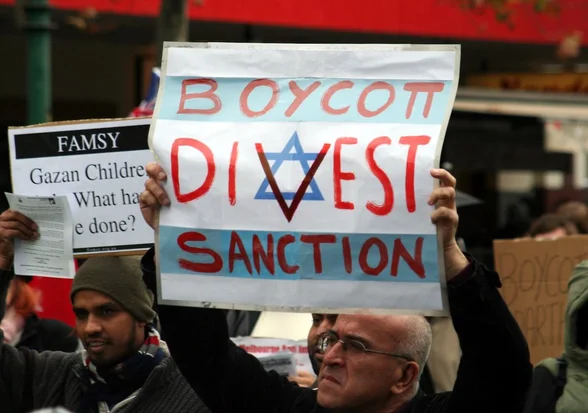
Republican Senators Ted Cruz, R-TX, and Marsha Blackburn, R-TN, called on the Biden administration to take more robust action against companies that violate U.S. legislation against anti-Israel boycotts.
According to the senators, among these problematic companies are financial firms that assign an ESG score based on a company’s performance in the environmental (E), social (S) and governance (G) fields.
The ESG rating system is meant to advise investors by providing measures to assesses the social sustainability of a company, factoring in corporate actions and values. However, according to the two GOP senators, these metrics could be used as a tool to discriminate against Israel, given its ongoing conflict with the Palestinians.
In a letter to the U.S. Department of Commerce, obtained by The Washington Free Beacon, the two senators wrote that “advocates of economic warfare against Israel have increasingly sought to use ESG criteria as pretexts for boycott advocacy.”
In their critique, Cruz and Blackburn highlighted Morningstar, one of the largest American financial services firms, stating that it “has echoed and amplified attacks by boycott-advocacy groups against companies that do business with Israel” through its ESG research arm, Sustainalytics.
The Senators noted that “companies that rely on ESG ratings in their business decisions have minimal transparency into the details, let alone motivations behind how the ratings were set. The practice introduces exposure to American anti-boycott laws along the entire chain, and most acutely for the firms opaquely designing and setting the ESG criteria.”
Last year, after Morningstar was slammed with accusations of being anti-Israel, the company employed a law firm to investigate the matter. As published in a report, the firm found that Sustainalytics derived data from “groups committed to boycotting Israel,” said the senators’ letter. It pointed specifically to three organizations: Who Profits, Human Rights Watch and Amnesty International.
“Advocates of economic warfare against Israel have increasingly sought to use ESG criteria as pretexts for boycott advocacy,” the senators wrote.
The report noted that Sustainalytics’ focus on Israel did not substantively differ from “the number of engagements with companies operating in China, Myanmar, Russia, Saudi Arabia and Western Sahara.” Yet the senators wrote that such an argument is “grotesque and is itself evidence of systemic bias.”
They also lambasted the report for failing to mention the “equally obvious point that incorporating the advocacy and targets of pro-boycott organizations guarantees the production of pro-boycott bias.”
A spokesperson for Morningstar told the Free Beacon that the company “in no way endorses the BDS movement” and is undertaking efforts to ensure none of its financial products unfairly target Israel.
Popular article:

interview Easter message of resurrection hope amid war at Jerusalem's Garden Tomb

biblical commentary Let my people go: a Passover message for today

4 IDF soldiers killed, 2 wounded in fighting in southern Lebanon, as Israel eliminates dozens of Hezbollah terrorists

Receive latest news & updates
A message from All Israel News
Help us educate Christians on a daily basis about what is happening in Israel & the Middle East and why it matters.
For as little as $10, you can support ALL ISRAEL NEWS, a non-profit media organization that is supported by readers like you.
Latest articles:

1969 Dutch Eurovision winner Lenny Kuhr moves to Israel – cites antisemitism, family ties

Israel bars French far-left leader Mélenchon in response to France's entry ban on settlement leader

Change Bloc divided over coalition with Arab or ultra-Orthodox parties after week of negotiations

Huckabee fires back as Senate Democrats target US-Israel intelligence ties: 'Shocking!'

Israeli blood test detects early breast cancer with 95% accuracy, assesses recurrence risk