Lapid warns against allowing Saudi Arabia to enrich uranium
Saudi uranium enrichment would lead to a nuclear arms race, Lapid says
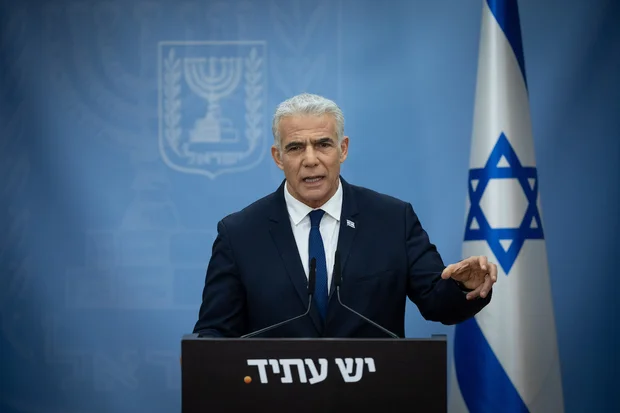
A deal allowing Saudi Arabia to enrich uranium would spark a dangerous arms race, opposition leader Yair Lapid warned in an interview with Israel's Channel 12.
“Israel can’t agree to uranium enrichment in Saudi Arabia, because it endangers its national security,” Lapid said.
“It would harm our campaign against Iran. It would lead to a regional nuclear arms race. Egypt and Turkey won’t agree to uranium enrichment on Saudi territory unless they can do it, too. But they will want Russian or Chinese technology,” Lapid argued.
His comments to Channel 12 news and a visiting US House Democrat delegation come amid concerns about the potential effects of the much-discussed deal to normalize relations with Saudi Arabia.
While Lapid is not opposed to a peace deal with Saudi Arabia, the Yesh Atid party leader emphasized that he would not support it at any cost.
“There is no problem with a civilian nuclear program,” Lapid said. “There are countries in the Middle East like the United Arab Emirates that have a civilian program. What they don't have is the ability to produce uranium."
“But with respect to Saudi Arabia, that is what is on the table now and it can’t be on the table,” he added.
The Likud party responded to Lapid's comments in a statement, saying "Prime Minister Benjamin Netanyahu delivered four historic peace agreements that only strengthened the security and prestige of the State of Israel and will continue to do so."
“Lapid, who gave Hezbollah Israeli gas reserves for free, should not preach to Prime Minister Netanyahu, who will continue to protect the security and vital interests of Israel in any peace settlement."
Two weeks ago, National Security Advisor Tzachi Hanegbi rejected media reports about likely concessions in a deal with Saudi Arabia and stressed that “Israel will not give in to anything that will erode its security,” the Times of Israel reported.
Regarding the possibility of Saudi Arabia building a nuclear energy plant, Hanegbi said Israel is not concerned because it “is not something that endangers them nor their neighbors.”
On Wednesday, the Wall Street Journal reported that the U.S. Biden administration and Saudi Arabia reached a broad understanding in outlining a Saudi-Israeli peace deal.
According to the report, U.S. officials have expressed optimism that such a deal could materialize over the next 9 to 12 months, however, the White House has since dampened the expectations.
U.S. National Security Council spokesperson John Kirby cautioned, “Quite frankly, just to be blunt here, I think the reporting has left some people with the impression that the discussions are farther along and closer to some sense of certainty than they actually are.”
Popular article:

interview Easter message of resurrection hope amid war at Jerusalem's Garden Tomb

biblical commentary Let my people go: a Passover message for today

4 IDF soldiers killed, 2 wounded in fighting in southern Lebanon, as Israel eliminates dozens of Hezbollah terrorists

Receive latest news & updates
A message from All Israel News
Help us educate Christians on a daily basis about what is happening in Israel & the Middle East and why it matters.
For as little as $10, you can support ALL ISRAEL NEWS, a non-profit media organization that is supported by readers like you.
Latest articles:

1969 Dutch Eurovision winner Lenny Kuhr moves to Israel – cites antisemitism, family ties
Israel bars French far-left leader Mélenchon in response to France's entry ban on settlement leader
Change Bloc divided over coalition with Arab or ultra-Orthodox parties after week of negotiations

Huckabee fires back as Senate Democrats target US-Israel intelligence ties: 'Shocking!'

Israeli blood test detects early breast cancer with 95% accuracy, assesses recurrence risk