











Jewish synagogue vandalized in Armenian capital, allegedly for Israel's growing ties with Azerbaijan
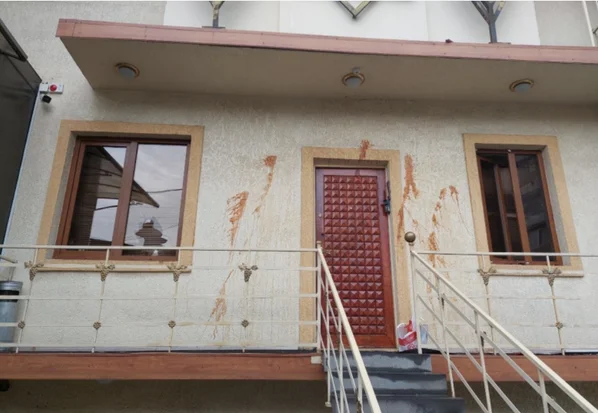
Unidentified vandals smeared red paint on the face of a Jewish synagogue in the Armenian capital Yerevan on Tuesday night in an attack that some believe may be related to Israel’s recent sale of weapons to Azerbaijan, Armenia’s long-standing adversary.
Following the incident at the Mordechai Navi Religious Jewish Center, a text circulated on pro-Armenian social media pages portraying the attack as retaliation against the Jewish state for its growing ties to Azerbaijan, according to the Times of Israel.
Supporters of the Armenian separatist government issued a statement, saying: “The Jews are the enemies of the Armenian nation, complicit in Turkish crimes and the regime of Azerbaijani President Ilham Aliyev. The Jewish state provides weapons to Aliyev’s criminal regime, and Jews from America and Europe actively support him. Turkey, Aliyev’s regime, and the Jews are the sworn enemies of the Armenian state and people.”
Israel obtains a large amount of its petrol from Azerbaijan and sells drones and other advanced weapons to the country, which lies partially between Eastern Europe and Western Asia.
The synagogue attackers also linked their vandalism to the recent criticism from American and European rabbis of Armenian Prime Minister Nicole Pashinyan for his statements equating Azerbaijan’s actions against the Armenian people with those of the Nazis in the Holocaust.
“His remarks belittle the terrible suffering experienced by the victims of the horrific Holocaust and the Jewish people at large," the rabbis wrote in a letter condemning Pashinyan's comment.
“If Jewish rabbis in the United States and Europe continue to support Aliyev’s regime, we will continue to burn their synagogues in other countries. Every rabbi will be a target for us. No Israeli Jew will feel safe in these countries,” the letter continued.
Rabbi Pinchas Goldschmidt, president of the Conference of European Rabbis, responded to the Jewish synagogue incident in Yerevan.
“The vandalism of the World Jewish Center in Armenia is distressing. The Jewish community in Armenia is not a party to the conflict in Nagorno-Karabakh,” Goldschmidt said on Wednesday.
He also called on Armenian President Vahagn Khachaturyan to condemn the act and stressed the need for increased security measures for the Jewish community there, adding that he stands “in solidarity with the Jewish community in Armenia” and prays that they “continue to celebrate the holiday of Sukkot and carry on their extensive activities.”
Jewish ties to Armenia date back centuries, with a large flux of Ashkenazi (European) Jews emigrating to the country during the 20th century from Russia and Ukraine.
When war broke out over the disputed Nagorno-Karabakh territory in the 1980s, several Jews made aliyah, immigrating to Israel, leaving only a few dozen behind in the capital city.
The war in Ukraine has since brought tens of thousands of Russians to Yerevan, including several hundred Jews, which added to the small community who previously lived there.
Popular article:

interview Easter message of resurrection hope amid war at Jerusalem's Garden Tomb

biblical commentary Let my people go: a Passover message for today

4 IDF soldiers killed, 2 wounded in fighting in southern Lebanon, as Israel eliminates dozens of Hezbollah terrorists

Receive latest news & updates
A message from All Israel News
Help us educate Christians on a daily basis about what is happening in Israel & the Middle East and why it matters.
For as little as $10, you can support ALL ISRAEL NEWS, a non-profit media organization that is supported by readers like you.
Latest articles:

Israeli Arab charged with spying for Iran, citing ideological motives
3 Israelis injured, 1 Palestinian woman killed in violent incident outside new Jericho settlement
Israel rises to world's 25th-largest economy despite war, boycott calls

US envoy Waltz visits Lebanon amid discussions over new peacekeeping force, stalled Hezbollah disarmament

Despite years of war, Israeli children and teens report high levels of life satisfaction, international surveys find