









Israeli scientists move closer to producing food from CO₂ in breakthrough research
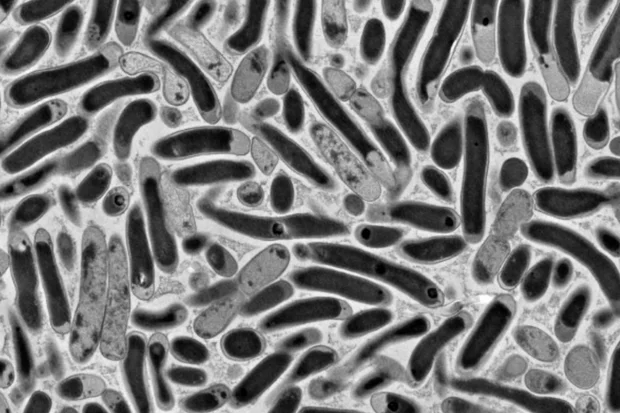
Scientists at Israel’s Weizmann Institute outside of Tel Aviv have achieved a breakthrough that brings them a step closer to producing food from carbon dioxide, advancing a long-term effort to develop sustainable microbial food sources for humans and animals.
While this might sound like fiction, researchers in the laboratory of Prof. Ron Milo have engineered E. coli bacteria with specialized “body structures” that allow them to absorb significantly larger amounts of CO₂ and grow more rapidly. The findings, presented earlier this month at the annual Israel Society of Ecology and Environmental Sciences conference in Jerusalem, build on the laboratory's earlier achievement of creating the world's first bacterium capable of growing by consuming carbon dioxide instead of carbohydrates.
“Our ambitious goal for our microbes is that they carry out a process similar to that undertaken by plants,” said Klil Halevi, a master’s student who is part of the research team. “Plants use water, CO₂, and the energy of the sun to produce carbohydrates with which to build their bodies,” he explained. “They are at the bottom of the food chain, providing energy, through carbohydrates, to herbivores, which are eaten by carnivores.”
Halevi also noted that today's food systems rely heavily on agriculture and livestock grazing, making them vulnerable to conflict and supply chain disruptions.
Businesses like Quorn and Remik already produce dairy proteins based on microbes. However, Halevi stressed that these food-producing processes are based on sugar-based feedstocks.
“It’s still agriculture,” Halevi said. “While the bacterial strains we have today are not yet ripe for the job, we hope that the genetic changes we are making will eventually allow for the efficient production of microbe-based food using only energy derived from the sun and CO₂. It’s almost like magic.”
Halevi said the team is focusing on microbes because they can produce proteins, carbohydrates, vitamins and other nutrients.
Despite the breakthrough, he cautioned that the technology remains years from practical use.
"It's not as if microbes will be producing sandwiches next year," he said.
“In theory, microbes could eventually supplement, or even replace, parts of our plant- and animal-based food systems. We are very far from that, but this is science that needs to be invested in. We’re moving fast; consider that it took plant-based agriculture 10,000 years to reach where it is today.”
While the vision remains decades away, the research reflects Israel's long-standing emphasis on agricultural innovation and food security.
With a tiny arid territory, limited farmland and scarce natural water resources, Israel was forced from its earliest years to innovate in order to develop an agricultural sector capable of feeding a growing population.
Despite its advanced agricultural sector, Israel remains heavily dependent on imported food. Last September, the Agriculture and Food Security Ministry unveiled a strategy to boost the country's food self-reliance in order to strengthen long-term food security.
"The goal is to prepare for the next crisis before it begins, shifting from a reactive approach to a preventive approach based on data and forecasts," Yuval Lipkin, head of the Israeli Food Security Administration, said at the time.
Popular article:

interview Easter message of resurrection hope amid war at Jerusalem's Garden Tomb

biblical commentary Let my people go: a Passover message for today

4 IDF soldiers killed, 2 wounded in fighting in southern Lebanon, as Israel eliminates dozens of Hezbollah terrorists

Receive latest news & updates
A message from All Israel News
Help us educate Christians on a daily basis about what is happening in Israel & the Middle East and why it matters.
For as little as $10, you can support ALL ISRAEL NEWS, a non-profit media organization that is supported by readers like you.
Latest articles:

North American Jewish organizations to recruit 100 professionals to combat antisemitism

‘No need’ for pre-election Iran strike, IDF chief says as gov’t, opposition trade blame for potential escalation – report

terror attack 2 Israeli soldiers killed, 2 terrorists eliminated in Hebron shooting; IDF says much larger attack was prevented

analysis A people dwelling securely? Israel’s strategic standing, 3 years after Oct 7

Hamas on wheels: What I found in Dearborn reveals a troubling history and a battle over Israel