IDF says 6 Hamas terrorists killed in firefight in Israeli-controlled part of Rafah after severe violation of ceasefire
NYT says IDF has destroyed more than 2,500 structures in Gaza since start of ceasefire




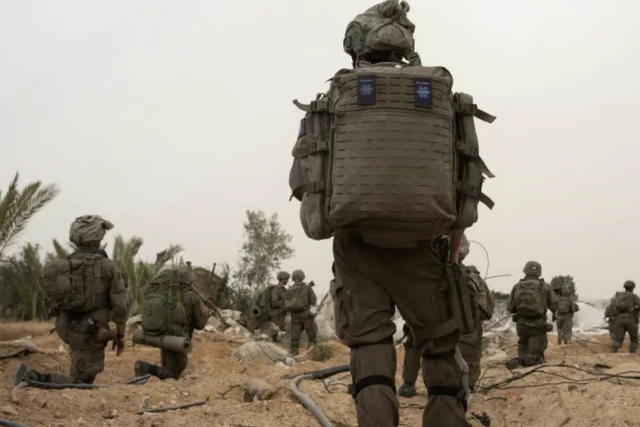
The Israel Defense Forces announced on Tuesday that its troops had been attacked by a group of Hamas terrorists in the area of Rafah, in the southern Gaza Strip, in a violation of the ceasefire agreement. Two Israeli soldiers were wounded in the ensuing firefight, but the IDF wasn't sure whether the terrorists had managed to escape or not.
On Wednesday morning, the military said that after conducting searches in the area of the firefight, six Hamas gunmen were found to have been killed during the engagement, and that multiple weapons were found on the fighters.
The incident occurred on the Israeli-controlled side of the Yellow Line in Rafah, which had been in the control of the Israeli military under the ceasefire negotiated in October.
According to Army Radio, IDF observers identified six armed terrorists emerging from tunnel shafts. The observers alerted nearby tanks, which fired at the terrorists. Despite Air Force support, the terrorists at first returned fire, managing to wound two soldiers before apparently managing to escape.
🎥BLATANT HAMAS CEASEFIRE VIOLATION: Yesterday, terrorists fired towards an IDF tank operating in southern Gaza, before being eliminated by IDF troops. pic.twitter.com/TDxc2qqmjv
— Israel Defense Forces (@IDF) January 14, 2026
The IDF stressed that the incident constituted a severe violation of the ceasefire agreement. Despite this, the IDF hadn't launched retaliatory strikes at the time of publication.
The firefight took place as U.S. President Donald Trump was expected to announce the beginning of the second phase of the Gaza peace plan on Wednesday.
The announcement could also include the names of the Palestinian members of the technocratic committee expected to assume oversight of the Gaza Strip, managing the civil and political affairs under the oversight of the Board of Peace, to be chaired by President Trump.
At the same time, the IDF noted that it had discovered a rocket launcher in the northern Gaza Strip on Tuesday, behind the Yellow Line. It was already loaded ready for a launch towards Israel. Israeli troops later discovered another multi-barrel rocket launcher in the southern Gaza Strip. Both launchers were destroyed by combat engineering units.
Also on Tuesday, a senior government official told Israeli media that the government has reason to believe that operatives within the Palestinian Islamic Jihad know the location of the remains of Israeli hostage Ran Gvili.
The official also said that Israel is “working every day, all day and night” in order to return the remains of Master Sgt. Ran Gvili for burial in Israel.
“The efforts are being done through the negotiating team, and contacts with the mediators, also through connections with the Americans, as well as intelligence actions,” the official stated.
The Hostages and Missing Families Forum, along with the Gvili family, urged Prime Minister Benjamin Netanyahu not to move into the second phase of the Gaza peace plan until Ran’s remains have been returned.
“Until Ran is returned, the State of Israel will not be able to close its deepest open wound or begin the process of recovery and healing that it so desperately needs,” said a statement by the Forum.
Earlier this week, the New York Times reported that Israel had demolished an estimated 2,500 or more structures in Gaza since the start of the ceasefire in October. While many of those demolitions took place on the Israeli-controlled side of the Yellow Line, the report showed satellite imagery which demonstrated that some of the demolitions had taken place on the Hamas side of the Yellow Line, apparently related to the demolition of Hamas' extensive network of tunnels, and the blowing up of booby-trapped buildings.
The Times published images from the Shejaiya neighborhood, showing demolitions in Hamas-controlled territory that appeared to create a “buffer zone” between the Israeli and Hamas sides.
Gaza political analyst Mohammed al-Astal told The Times that the demolition had “no security justification.” However, the liberal U.S. news outlet also admitted that it had been exposed to a classified IDF map of Shejaiya, which showed an extensive tunnel network in the neighborhood.
The Israeli military has continued to destroy tunnel infrastructure within Gaza during the period of the ceasefire, as is permitted under the ceasefire terms.
You might also like to read this: