Has the tide turned against Hamas within Gaza?
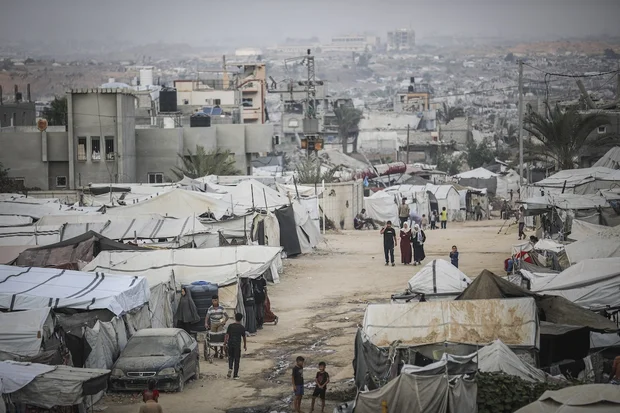
A Palestinian commentator recently made the extraordinary claim that just 10% of Gazans now support Hamas, saying there has been a “shift.”
But to what extent is that true?
Ahmed Fouad Alkhatib, born in Gaza and now based in Washington, is affiliated with the Atlantic Council think tank. In his book, "Hamas and its Two Million Hostages," he challenges the prevailing view that Hamas enjoys widespread support in the Gaza Strip.
Speaking with host Joel Rosenberg on TBN program THE ROSENBERG REPORT, Alkhatib suggested that there was a “window” of opportunity for change.
“I believe there's a willingness to go for something fundamentally different, that moves Gazans away from the armed resistance narrative, toward the nation building agenda, to ensure that this is Gaza's last war, ultimately in pursuit of the peace and coexistence reality that we see,” he said.
Supporting Alkhatib’s assertions, videos of children learning the Hebrew language and sending messages of friendship have recently appeared on social media.
“Shalom! How are you today? Is everything ok?” asks one young woman in Hebrew who is wearing a hijab and smiling.
“How are you? My name is Malek Al Henawi,” says another little boy, with footage of others sending similar messages, saying how they are enjoying learning the Hebrew language.
The video was posted by Builders of the Middle East, a platform founded by Nuseir Yassin, better known as Nas Daily, who is from Arraba in the Galilee region. Yassin previously described himself as “Palestinian-Israeli,” but told his followers after Oct. 7, 2023, that he now identifies as an Israeli Palestinian.
The NGO attempts to humanize different communities to foster dialogue and connection, describing itself as “committed to promoting peace, tolerance, and cooperation across the Middle East,” so it would be more inclined to highlight peaceful voices even if they are in the minority.
There are other influencers who continue to promote a message of peace and hope. Reports of teachers in Gaza working to keep Hamas propaganda out of classrooms, along with public condemnation of the group’s abuses on social media, suggest that Hamas does not enjoy the widespread and enthusiastic support it once did.
Some Gazans speak out publicly against Hamas, while the Center for Peace Communications and The Free Press have sought to amplify voices of dissent on a YouTube channel dedicated to that purpose. Such public expressions of dissent, however, have been relatively few and far between.
However, crowds of Gazan dissidents came out onto the streets in large numbers before and even during the war; those objecting to Hamas bravely demonstrated in the streets under the banner “We want to live." The demonstrations were met with violent repercussions and soon came to an end.
While voices speaking out against Hamas are seldom heard in the English media, Alkhatib insists that his opinion is “far from rare” in the Gaza Strip, where people are “fed up with Hamas.”
At the same time, he clarified that hating Hamas was not the same as supporting Israel. He criticized specific decisions made by the Israeli government and armed forces during the war, acknowledging that many civilians in Gaza are still committed to Hamas.
“Is there ideological support for Hamas in Gaza? Absolutely, without a doubt. That still very much exists. But I would argue that that is such a minor, minor part of the population. In my assessment, I don't think that cracks at best 10% of the Gaza Strip,” he said.
“They are tired of endless wars,” said Alkhatib. “They look at the totality of the group's rule for the last 20 years. They look at the arc of Hamas over the last four decades, how it has arrested the development of the Palestinian people, forestalled progress, wasted tens of billions of dollars, resulting in the deaths of tens of thousands of Palestinians, all for nothing.”
An anonymous source who works with Muslim-background believers in Gaza said she believes opposition to Hamas is widespread in the Strip, citing what a new believer there had told her.
“He said that many people don't like Hamas anymore,” she said, pointing to the street protests during the war. “It's very hard to go against them because there's no other way to live,” she explained, saying that violent retribution from the terror group was not the only concern. Many are dependent on Hamas for their livelihoods and even their food.
“Maybe it’s because of the war and what has happened, but they are more open to talk,” she said.
She said that people were now using the name of Jesus and openly mentioning Hamas, whereas previously they had spoken in code to avoid detection. “They are less afraid than before,” she added.
She also said she believed many Gazans would prefer Israeli control to continued Hamas rule.
“It would be better for them for sure,” the source said.
The account points to signs of growing discontent with Hamas. Still, it is hard to know whether these voices reflect a wider change in how Gazans feel about Hamas.
Has the tide really turned? Let’s hope so.

Support our independent, on-the-ground reporting from Israel. Become a $5/month Ally.
Popular article:

interview Easter message of resurrection hope amid war at Jerusalem's Garden Tomb

biblical commentary Let my people go: a Passover message for today

4 IDF soldiers killed, 2 wounded in fighting in southern Lebanon, as Israel eliminates dozens of Hezbollah terrorists

Receive latest news & updates
A message from All Israel News
Help us educate Christians on a daily basis about what is happening in Israel & the Middle East and why it matters.
For as little as $10, you can support ALL ISRAEL NEWS, a non-profit media organization that is supported by readers like you.
Latest articles:

Haredi UTJ party won’t recommend Netanyahu as PM, Eisenkot set to win President’s mandate to establish new gov’t
Massive pro-Israel rally draws tens of thousands in Peruvian capital

After Republican losses in Congress, Vance says America needs to 'change its relationship to Israel'
Jerusalem mayor hopes $20 million sports center will foster 'friendship between Jews and Arabs'

Israel's Elections Committee finds no evidence of vote-rigging after review