Haredi UTJ party won’t recommend Netanyahu as PM, Eisenkot set to win President’s mandate to establish new gov’t
President probes parties' readiness for compromise, join unity government
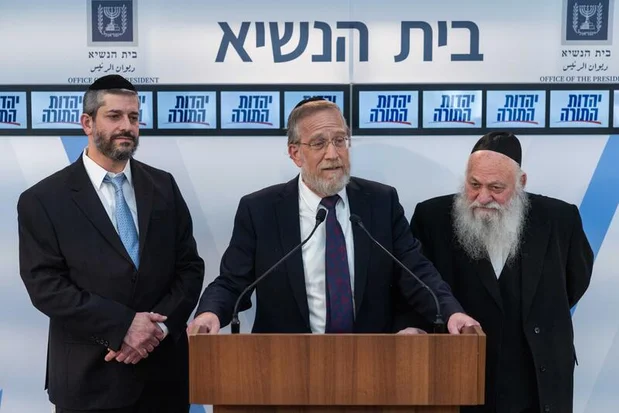
In a dramatic break, the ultra-Orthodox United Torah Judaism (UTJ) party announced it won’t recommend Benjamin Netanyahu as prime minister, effectively deciding the race in favor of Yashar’s Gadi Eisenkot, who will likely receive the mandate to establish a new government.
The UTJ’s group of representatives made the announcement at President Isaac Herzog’s residence on Thursday morning. The president is meeting with officials from all parties to discuss who they support as their candidate for prime minister.
The president has broad discretion in his decision but usually tasks the candidate with the most supporters with forming a government. If he fails, the president can give the mandate to another candidate.
This is the first time in over two decades that UTJ hasn’t recommended Netanyahu as its candidate. This leaves him with only 46 votes compared to Eisenkot’s 56, after the Arab Islamist Ra’am party announced it would vote for him as well.
Netanyahu has the recommendations of Shas, Religious Zionism/Zehut, and Jewish Power, while Eisenkot has the support of Together, Yisrael Beitenu, The Democrats, and Ra’am; only the Joint List hasn’t announced its decision yet.
The recommendation votes are completely unrelated to the coalition negotiations, making it far from certain that either UTJ or Ra’am will join Eisenkot’s government. They are seen as more likely to lend him outside support for a minority government.
The consultations are being live-streamed and are scheduled to take place from Wednesday to Thursday, starting with the smallest parties and concluding with the Likud party, which received 27 Knesset seats in the elections, on Thursday evening.
“We received instructions from the rabbis not to recommend anyone for Prime Minister,” the UTJ’s representatives announced at the start of the meeting with Herzog.
MK Yitzhak Pindrus explained, “We expect any government that is formed to put the persecution of Torah scholars at the top of the issues it addresses, because this is something incomprehensible.”
“We are talking about the principle of ‘Torato Umanuto’ [those for whom Torah study is their main occupation]. The same applies when discussing sanctions: obviously, anyone who breaks the law should face sanctions, but there should not be a law that makes a yeshiva student a criminal,” Pindrus said.
President Herzog responded by asking, “Do you have an outline that differs from what we have had until now – that is, an option to legislate a conscription law that could achieve broader agreement? Are you willing to move away from the broad positions you have held until now? And is your position clear that anyone who does not study Torah will enlist?”
“The legislation we are talking about concerns those whose occupation is the study of Torah. This was defined in law; it was defined in law and changed following the Tal Law, not before that,” Pindrus replied, prompting Herzog to praise “other models,” like the IDF’s new Hasmonean Brigade.
However, on Thursday morning, Pindrus apparently walked back in another statement, saying, “We are part of the bloc of faith-based parties, but we expect a solution for Torah students. At present, there are no contacts whatsoever with the left-wing bloc.”
Much of the discussion during the consultations so far focused on a potential unity government, with Herzog probing and questioning the party’s readiness for compromise.
During the consultation with Yisrael Beitenu, Herzog questioned party leader Avigdor Liberman’s statements ruling out coalitions with the ultra-Orthodox and Arab parties, and with Netanyahu: “If you won’t sit with this one or that one or the other one – where does it lead?” Herzog wondered.
“The current government is not right-wing in its policies,” MK Oded Forer responded. “They have not taken responsibility for the October 7 massacre. We cannot be expected to hand them the keys.”
“So what’s left? Who do you intend to sit with?” Herzog pushed, to which Forer responded that there were perhaps “elements within Likud” who could defect and cooperate with the Change Bloc.
On Wednesday, Herzog received representatives from Religious Zionism, which won six seats in a technical alliance with Zehut, whose chairman made his own recommendation separately.
MK Orit Strock called for a “broad national government” under Netanyahu’s leadership: “We need to sit together without boycotts, and reach understandings and agreements,” she urged.
In their discussion, Herzog pushed back on the refusal to work with the Arab parties, which he warned is bordering on racism.
“We believe the Arab parties are not legitimate participants in this process, not because they are Arab, but because they are nationalists,” Strock replied.
Herzog, in response, asked, “How do you distinguish between racism and what you’re saying?” He also noted that the Jewish No. 2 candidate on Ra’am’s list, Yoav Segalovitz, was a police commander. “This generalization really bothers me,” he said.
The president also pushed back against claims the elections were “stolen” by the Arab parties, which were brought up by Religious Zionism representative Zvika Mor, who warned there is an attempt to “take over” the state “under the guise of democracy.”
“That is a very dangerous remark,” Herzog responded, “to claim that another side is carrying out a takeover from within is extremely dangerous.”
Once Eisenkot receives the mandate as expected, he will receive a maximum period of 42 days to form a coalition.
Popular article:

interview Easter message of resurrection hope amid war at Jerusalem's Garden Tomb

biblical commentary Let my people go: a Passover message for today

4 IDF soldiers killed, 2 wounded in fighting in southern Lebanon, as Israel eliminates dozens of Hezbollah terrorists

Receive latest news & updates
A message from All Israel News
Help us educate Christians on a daily basis about what is happening in Israel & the Middle East and why it matters.
For as little as $10, you can support ALL ISRAEL NEWS, a non-profit media organization that is supported by readers like you.
Latest articles:
Massive pro-Israel rally draws tens of thousands in Peruvian capital
After Republican losses in Congress, Vance says America needs to 'change its relationship to Israel'

Has the tide turned against Hamas within Gaza?

Jerusalem mayor hopes $20 million sports center will foster 'friendship between Jews and Arabs'
Israel's Elections Committee finds no evidence of vote-rigging after review