Haredi Jewish Londoners learn Krav Maga amid uptick in antisemitic violence



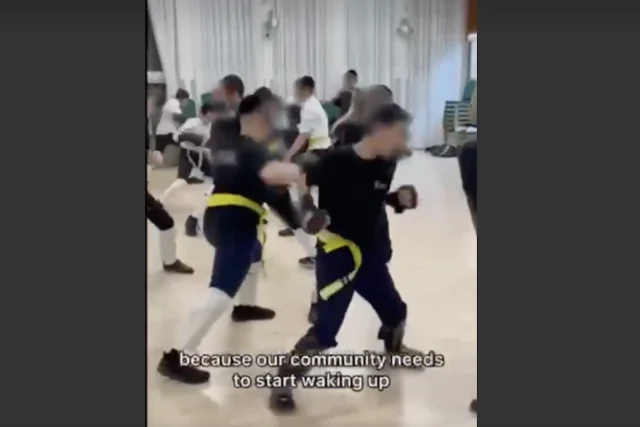
As antisemitic incidents and concerns about personal security continue to rise in London, a former Israeli soldier is teaching Krav Maga (an Israeli self-defense system) to members of the city’s Haredi Jewish community, giving them tools to defend themselves while maintaining the community’s distinctive way of life.
Keinan David, who grew up in South Africa before making Aliyah to Israel at age 18, learned Krav Maga during his IDF service. Now living in London, he runs a fitness and martial arts club specifically adapted for the Haredi community, where he says demand for self-defense training is growing.
“When I walk down the street in London, I could be anyone. Nobody knows I’m Jewish, but Haredi Jews are an obvious target for antisemites, and my goal is to teach them how to protect themselves,” said David.
“I have a club dedicated entirely to the Haredi community, with all the adaptations and nuances that come with it,” he said. “It takes time to reach them, convince them that it matters and give them the tools, but I can see the change and the desire to learn. It’s growing.”
David said his childhood in South Africa provided little exposure to antisemitism, but concerns about personal safety and crime eventually influenced his decision to move to Israel.
“South Africa was a kind of bubble for me. We went to a Jewish school and spent most of our time inside the community,” he said. “I don’t think there was much antisemitism, but personal security and crime were always issues, and they only got worse over the years.”
After moving to Israel, David enlisted in the IDF and later trained in martial arts while adjusting to life outside the military.
“Being in the army and entering the Israeli workforce are completely different things,” he continued. “After the army, I felt I needed some space, and I didn’t really have a clear plan for what I was going to do. I trained in martial arts, and it was a kind of healing process for me.”
Soon afterwards, David’s wife completed her IDF service, and the young couple moved to London, where they had relatives, to build a new life.
“That was 10 years ago, and we’re still here, part of the local community,” he said, adding that he worked in the private security industry before opening his own fitness and martial arts clubs for Jewish clients.
When David began trying to attract Haredi clients, however, he found that reaching the community required a different approach.
“The marketing, the branding, everything has to be different and adapted to their community,” he said. “I can’t market it with any reference to aggression, and I hardly use the words ‘self-defense,’ because that can be problematic.”
Instead, David said his outreach focuses on health, physical fitness, self-discipline and confidence. Many of his clients are children and young people whose parents are concerned about problems they are experiencing at school or who need a healthy outlet for excess energy.
“I incorporate a lot of fitness work into the training, but we absolutely train in self-defense as well. I just don’t market it that way,” he explains.
Since the Hamas attacks on Israel on Oct. 7, 2023, David said, the Jewish community in London, including its Haredi segment, has become increasingly aware of the need for greater vigilance and personal security.
“There is definitely a change and a rise in awareness,” he said.
“Many of them still deliberately ignore what’s happening around them because they don’t like being distracted from their religious lives. There is a certain percentage of the Haredi community that will never walk into my club for exactly those reasons, and that’s fine. (But) precisely because they are so visibly identifiable, and because there are threats against them, I felt there had to be at least one person giving them a chance to defend themselves if something happens,” he continued.
David said the increasingly hostile atmosphere also extends to London’s broader fitness and martial arts scene, where some Jewish residents encounter people openly expressing hostility toward Israel and Jews.
“You can run into people saying terrible things about Israel, train alongside someone wearing a Palestine shirt and see all kinds of fundraising events for Gaza,” he said. “Because of that, a lot of Jews don’t train in places like that and look for something more communal.”
Despite those concerns, David said he makes a deliberate effort to keep his clubs welcoming rather than letting them become places defined by hostility toward others.
“I try not to give the vibe of, ‘Come on, let’s fight terrorists,’ or constantly talk about antisemitism,” he said. “The goal is for the class to be useful, but also friendly and enjoyable.”
“There is definitely more anxiety in the community,” he concluded. However, he also said that “People simply continue living their Jewish lives. They’ll keep going to synagogue, wearing kippahs in the street and sending their children to Jewish schools,” David said. “We’ll see a much greater security presence around all of that, but we’re not going to give up Jewish life, including in public spaces.”
You might also like to read this: