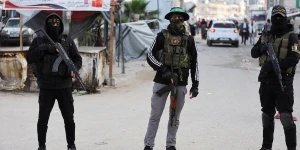
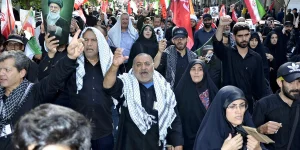
Hamas says it's ready to discuss 'freezing or storing' weapons but unwilling to disarm
Bassem Naim's comments reveal deep gaps between Trump peace plan and Hamas positions



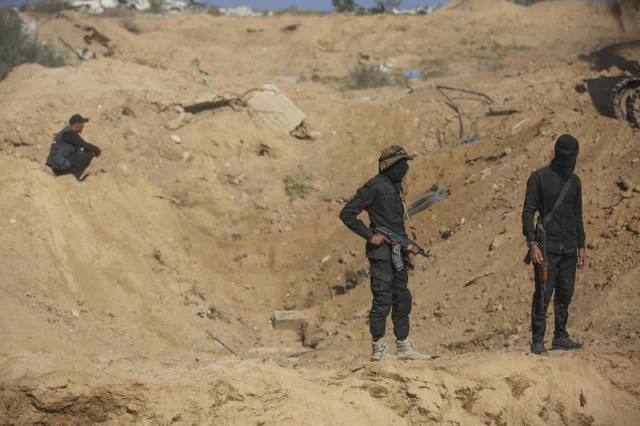
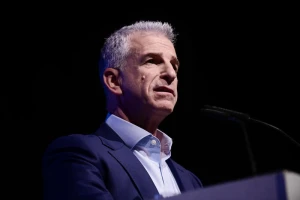
Hamas political official Bassem Naim on Sunday said that the terror organization might be willing to discuss “freezing or storing” its weapons as part of a ceasefire agreement, but reiterated the group’s insistence on holding on to its arms.
“We can talk about freezing or storing or laying down, with the Palestinian guarantees, not to use it at all during this ceasefire time or truce,” Naim said during an interview with the Associated Press in Doha, Qatar on Sunday.
Naim’s comments come as the United States, along with several of the guarantor nations of the 20-point peace plan put forward by U.S. President Donald Trump, are interested in moving to the second phase of the agreement, which would begin to see more activity on the ground in Gaza.
However, Israel has resisted moving on to the next phase until two conditions of the first phase are met: the return of all hostages and hostage remains, as well as the disarming of Hamas.
The Trump peace plan calls for Hamas to be disarmed and the Gaza Strip to be turned into a demilitarized zone, with the IDF withdrawing its troops from the enclave after Hamas is disarmed.
However, in a speech to a Turkish conference calling for the worldwide Muslim community to stand with the Palestinians and to renew Islamic authority over Jerusalem, Hamas political head Khaled Meshaal said the terror group would not surrender its weapons, nor agree to a foreign “guardianship” over the Gaza Strip, as is called for in the Trump peace plan.
Naim said Hamas is willing to discuss the next phase of the agreement, in order to avoid “further clashes.”
“We are open to have a comprehensive approach in order to avoid further escalations or in order to avoid any further clashes or explosions,” Naim told The Associated Press. However, he conditioned that on the initiation of “a political process which has to end with an independent Palestinian state.”
The second phase, which would involve difficult issues, such as the deployment of an international stabilization force (ISF), the formation of a technocratic Palestinian committee to administer Gaza, the withdrawal of Israeli troops, and the disarmament of Hamas, are still disputed by both Israel and Hamas, as well as within the nations signing on to the Trump peace plan.
An international board, led by President Trump, is set to be announced soon to oversee the implementation of the deal and the reconstruction of Gaza.
Naim reiterated two important points: Hamas is willing to make a temporary truce or ceasefire with Israel, but it insists on the implementation of a political track to a Palestinian state.
“And during this time [the second phase], we can go for five, seven, ten years, ceasefire or truce,” Naim stated. “Hamas is open to discuss such ideas within the context of a long-term ceasefire or truce, within the context of a track, political track, which have to lead to a Palestinian state.”
He also insisted that Hamas retains its “right to resist,” but said the terror organization would consider “freezing or storing” its weapons during the ceasefire.
“We are ready to discuss the idea of storing or freezing based on total security arrangements,” Naim repeated. “First of all, [those weapons] which keep the capability of Palestinians to defend themselves in case they are attacked.”
Naim also criticized the Trump peace plan, saying, “The plan is in need of a lot of clarifications.”
One area of contention is the role of the ISF in disarming Hamas, which Naim said would be unacceptable to Hamas. Hamas sees the role of the ISF as monitoring the agreement, not enforcing it from inside Palestinian territory.
This statement by Naim was consistent with that of Turkish Foreign Minister Hakan Fidan, who stated that the ISF should sit on the border between Israel and Gaza, but not be inside the enclave. It is likely that Turkey and Hamas coordinated this position before the Doha Forum, as Hamas leaders in Turkey recently met with Turkish officials, including Hakan Fidan, to discuss next steps in the implementation of the peace plan.
“We are welcoming a U.N. force to be near the borders, supervising the ceasefire agreement, reporting about violations, preventing any kind of escalations,” Naim told the AP. “But we don’t accept that these forces have any kind of mandates authorizing them to do or to be implemented inside the Palestinian territories.”
The Trump peace plan, which was ratified by UN Security Council Resolution 2803, calls for the ISF to operate within the Gaza Strip, enforcing the peace.
Naim’s comments come as Prime Minister Benjamin Netanyahu signaled that the second phase of the ceasefire could start soon, along with reports that President Trump intends to announce the composition of the Board of Peace by next week.
Speaking during a joint press conference with German chancellor Friedrich Merz, he said, “Phase one, we're almost there. We have one more deceased hostage, Ran Gvili, a hero of Israel, to return here. And then we very shortly expect to move into the second phase, which is more difficult, or equally difficult.”
You might also like to read this: