











‘Friendship is no insurance policy’: Jewish leaders warn of rising antisemitism in Romania
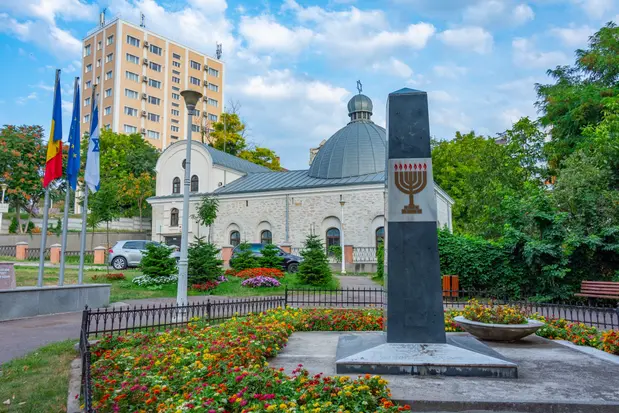
Growing antisemitism in Romania is raising concern among the country’s Jewish community, as conspiracy theories and anti-Jewish stereotypes gain traction despite the country’s diplomatic ties with Israel.
The issue was highlighted at a recent ceremony at Yad Vashem in Jerusalem, hosted by AMIR, the organization representing Israelis of Romanian origin, to commemorate Romanian Jews who perished in the Holocaust.
The event also marked the 10th anniversary of the death of Nobel Peace Prize laureate Elie Wiesel, who chaired the international historical commission that examined Romania's role in the Holocaust.
Discussions included findings from a 2025 survey showing a sharp rise in the number of Romanians who agree with the statement that “Jews seek to undermine the societies in which they live.”
The survey also found that 35% supported limiting the number of Jewish people allowed to work in certain professions. A similar proportion believed it would be better for Jewish people to leave the country, while 30% said Jews use Romania’s role in the Holocaust to blackmail the country.
Although these percentages remain lower than those recorded in some other European countries, the growing number of Romanians expressing such views has alarmed the country’s Jewish community.
A report published in July by the Elie Wiesel National Institute, covering the period from May 2025 through April 2026, documented numerous incidents in which figures associated with the fascist Legionary Movement, as well as convicted Holocaust-era war criminals, were glorified and presented as examples of the leadership Romania needs today.
Silviu Vexler, a Romanian lawmaker and president of the Federation of Jewish Communities in Romania, has repeatedly warned about the growing acceptance of antisemitic tropes, particularly on social media. His warnings have also made him a target of online abuse.
"There was a time when Holocaust remembrance ceremonies were enough. We were convinced that history, and all the knowledge we shared with society, would produce the results we had hoped for," he said.
Vexler said the world has since changed, with antisemitism and extremism becoming increasingly visible.
"We woke up in a world where antisemitism has erupted on a global scale, in a society where hatred and extremism have become commonplace," he stressed.
Vexler added that remembrance must be accompanied by action.
"It is no longer enough to fight these things with words alone, with good intentions alone, with remembrance ceremonies alone, and perhaps it never was," he continued. "More than ever, people everywhere need to take a stand, try to stop the hatred and do their part to contain it."
Micha Harish, a former Israeli trade and industry minister and chairman of AMIR, also warned that centuries-old stereotypes and conspiracy theories about Jews supposedly controlling the media and economy are resurfacing in Romania and elsewhere.
"These are patterns reminiscent of the 1930s," Harish said, adding that although the diplomatic ties between Bucharest and Jerusalem are important and helpful, "The friendship between the countries is important, but it is no insurance policy against what is happening within society."
The concerns are also reflected in the experiences of Israelis living in Romania.
Efi M., an Israeli who moved to the country with his family for work several years ago, told ALL ISRAEL NEWS that he has noticed “a latent mild dislike of Jews that is ingrained in the older generation, especially those that went through communism, although many haven't even met a Jew. It comes out in casual conversation via use of common derogatory epithets for Jews, such as the slur 'Jidan.'"
He also criticized the behavior of some Israeli tourists, saying that “especially since the advent of the Swords of Iron war, together with the rest of Europe, Israelis are more and more perceived as undesirable and even anathemic in extreme cases.”
Nevertheless, he said Israeli visitors who behave respectfully are generally treated much like tourists from other countries.

Support our independent, on-the-ground reporting from Israel. Become a $5/month Ally.
Popular article:

interview Easter message of resurrection hope amid war at Jerusalem's Garden Tomb

biblical commentary Let my people go: a Passover message for today

4 IDF soldiers killed, 2 wounded in fighting in southern Lebanon, as Israel eliminates dozens of Hezbollah terrorists

Receive latest news & updates
A message from All Israel News
Help us educate Christians on a daily basis about what is happening in Israel & the Middle East and why it matters.
For as little as $10, you can support ALL ISRAEL NEWS, a non-profit media organization that is supported by readers like you.
Latest articles:
Amid heightened tensions, Iranian regime unveils ‘missile city,’ claims to damage U.S. higher jet

Israeli budget airlines Israir, Arkia prepare to expand international routes

Following multiple attacks on Arab towns in Judea & Samaria, Eisenkot condemns 'Jewish terrorism’

ANALYSIS Can Israel and the US finish the job if they attack Iran again?

interview ‘Antisemitism is eroding liberal democracy’: UK Lord Eric Pickles sounds alarm over growing Jew hatred