opinion What the toothless man in Tur'an taught me about Israel’s elections
I was never meant to spend my morning on election day in Tur’an much less be in Tur’an at all. But in doing so, I was afforded insight into a demographic and input about the election from people who I never would have met or interacted with. Especially talking politics with the 70-year-old man with one tooth.
I had been traveling across the Galilee for over a week with our group of Christian volunteers harvesting olives and making oil as part of Root & Branch. Other than a meaningful olive harvest pilgrimage that connects Christian visitors to the Land and the people in really meaningful ways, I found myself connecting with other Israelis outside my Judean mountain bubble throughout the week.
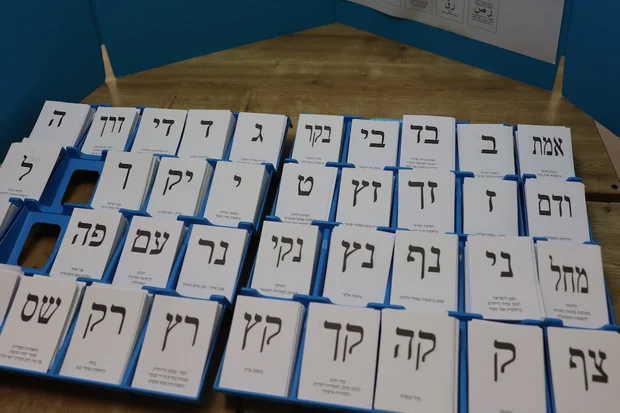
Israel’s electoral system is unique. There is no early voting. There is no absentee ballot. You vote for a party for parliament, not a candidate for specific office. You must show ID which is checked at the polling station at least twice. And you cannot vote outside your own home polling station except with very slight exception.
Not unique, but noteworthy especially in the face of the accusations that Israel is an apartheid state, all Israeli Arab citizens – roughly 20% of the country – have an equal voice and vote. And because I spent 10 days across the Galilee with its large Arab population, I had several spontaneous interactions with Israeli Arabs.
I thought that because I was traveling with a group, I would be given the opportunity to vote in another polling station near where I was staying. I arrived before the polling station opened and waited behind four others - along with two members of my group – who had arrived before me. When my turn came, I was told I was wrong. Not the first time being wrong about something, but frustrating all the same.
Since voting in a democracy is a privilege, and voting in the Jewish state whose sovereignty was only restored 78 years ago is a historic opportunity still even though I have voted in several Israeli elections since 2004, there was no way I was going to miss my opportunity to vote. Regrettably, I was left with the only option to drive 2.5 hours home, and then back to the Galilee, all in the same day, just to exercise my right and this privilege.
But first I had another problem to deal with. A flat tire in the van I rented to transport our olive harvesting equipment. Not just low air, but completely flat.
Because election day is treated almost as a national holiday, and to encourage widespread voting, it’s also a day off work for most, by law. I called the mechanic at Kibbutz Lavi who was off. I begged for someone to come to meet me with a compressor to fill the air and give me hope that I might get on the road at all. Chen answered immediately. He took no money.
Now I had enough air – hopefully – to get to a place where I could get the tire fixed. There was one 10 minutes to the east and another one 12 minutes to the west. I called the first. “We are closing in 10 minutes.” I begged him to receive me. No luck. I set out for the second option in Tur’an, an Arab village of about 15,000. I found the garage, and was helped immediately.
While I was waiting, I struck up a conversation with a 70-year-old man with one tooth. As Israelis on election day would, we spoke about politics. “Who did you vote for,” I asked in a way that Israelis are prone to do and which fast tracks the most elementary conversation into something personal in no time.
I was floored by my new friend’s answer. “Shas. I have always voted for Shas since 1984.” In the heart of an Israeli Arab community in which one would expect someone to vote for one of two Arab parties in the Israeli Knesset (yes, another debunking of the simple allegation of apartheid), the man said he voted for one of two of Israel’s main ultra-Orthodox Jewish parties. His explanation floored me, but he seemed sincere. I was impressed.
During the week I also encountered others I never would have met. An Israeli Arab mango vendor. “Anyone but Bibi” because he didn’t like the racism stirred by Internal Security Minister Ben-Gvir or the lack of effort by him to solve the problem of crime in the Arab sector.
I met a Chrisitan Arab bus driver who was wavering between Netanyahu and Gadi Eisenkot, Netanyahu’s main opponent for prime minister as (seeming) head of the anti-coalition opposition. A confused choice I felt.
I met a Druze bus driver who use to vote for Netanyahu and Likud religiously, but could not bring himself to do so now. But he wasn’t sure who he would vote for.
I met a Jewish taxi driver who was voting for Eisenkot because “Netanyahu and the government needed to be punished for the failures of October 7.” I countered that rather than being punished, they simply needed to take responsibility – along with a host of others. He concurred.
Through these conversations, many also bemoaned the economic situation, that the cost of living has gotten so expensive there just needed to be a change.
As I paid my 50 shekels for repairing the flat tire and before getting on the road, I asked the owner of the garage who he was voting for. “The Joint List” he declared, a confederation of three largely Arab parties that run on a joint list to be sure they will all be elected and not lose votes. He added that he specifically supported the Hadash faction within the Joint List, typically known as the communist branch of the three Arab party coalition members and noteworthy that it also has always had a Jewish Israeli high up on its own list for Knesset. I had so many questions for him but really wanted to get on the road. Does he support the right of Israel to exist at all as a Jewish state? Only in the framework of a “two-state solution,” or in some other paradigm? Is he a proud Israeli or does he consider himself a Palestinian? So many questions.
This didn’t surprise me. Arab voter turnout was expected to be high, in part because of a failed attempt to ban the Joint List from this year’s election. The backlash would be inevitable. In Tur’an for instance, more than 90 percent of the voters in the 2022 election voted for one of two main Arab parties.
The fact that no Israeli Jewish/Zionist parties that were elected to Knesset put a single Arab in an electable position on any of their respective lists as compared to past years made it much more difficult to make the case that Israeli Arabs have an alternative political home also contributes to this reality. In Tur’an for instance, I did not see a single banner for a single Jewish/Zionist party as if they all were just ceding the territory and electorate to the Arab parties and therefore the inevitable conclusion. That’s a bigger conversation for another time.
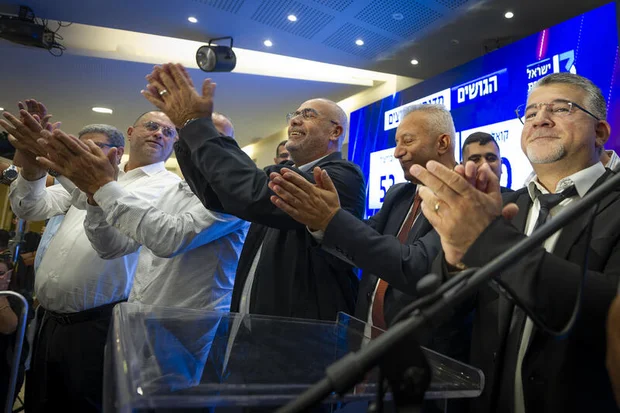
Indeed, the Israeli Arab vote was high, and the two Arab parties have received a near record vote which will elevate them and their influence in the Knesset and Israeli society. It’s noteworthy to think that if in any way a government is able to be formed with most or all of the main Jewish/Zionist parties, that could leave the Joint List as head of the opposition in the parliament of the Jewish state, and all the rights and privileges and responsibilities that this entails. It may or may not happen, but the simple fact that it could happen is just yet another indication that the trope of apartheid in Israel is a baseless lie.
I wonder if my one-tooth friend speaks openly about who he supports politically in his own community and how he might be received. While the October 7 Hamas attack and massacre has polarized elements of Israeli society, at the same time in many ways Jews and Arabs exist and suffer the same kind of threats and economic hardships nationally. Not this time, but can the voices of the Arabs I met who otherwise support Jewish/Zionist parties ones that can be amplified? Is there a kernel of opportunity to see some more widespread collaboration? Should they be? These are just a handful of questions that came out of my ten days in the Galilee, and my flat tire in Tur’an.
The votes have been counted but the outcome has yet to be determined. Israel may yet somehow cobble together a coalition from the outcome of this election, or we may be back to square one with no coalition possible and new elections in several months. I will be hosting a webinar analyzing the outcome and what the possibilities are that may be in store, this coming Sunday at 9:00pm Israel time, 2:00pm Eastern, 11:00am Pacific (US). Participation is free. Advance registration is required.
Popular article:

interview Easter message of resurrection hope amid war at Jerusalem's Garden Tomb

biblical commentary Let my people go: a Passover message for today

4 IDF soldiers killed, 2 wounded in fighting in southern Lebanon, as Israel eliminates dozens of Hezbollah terrorists

Receive latest news & updates
A message from All Israel News
Help us educate Christians on a daily basis about what is happening in Israel & the Middle East and why it matters.
For as little as $10, you can support ALL ISRAEL NEWS, a non-profit media organization that is supported by readers like you.
Latest articles:
With over 85% of votes counted, Israeli elections end without clear path to viable coalition

Trump to impose unity government on Israel? - Reports claim US president pushing for government without controversial ministers

US tells Gulf nations to prepare for possible military campaign in Iran following midterm elections
The last votes that could change everything – Israel awaits count of 600,000 'double envelopes'
Election uncertainty weighs on shekel as Israeli stocks fall