UN must abandon two-state solution and adopt HKOPS
Secretary-General Antonio Guterres 35th quarterly Report on the implementation of Security Council Resolution 2334 - adopted on 23 December 2016 - repeats the same pathetic message he has been delivering to the world community in previous reports without showing any tangible results.
Guterres writes:
“The UN stands ready to support all efforts to advance a just, comprehensive, and lasting peace. The continued devastation and misery on the ground, particularly over the past two years, have reinforced the absolute need for Israelis, Palestinians, regional States, and the broader international community to take urgent steps that will end the unlawful occupation and enable the parties to re-engage on the long-delayed political path to resolve the Israeli-Palestinian conflict in line with international law and UN resolutions, realizing a two-State solution – Israel and Palestine, of which Gaza is an integral part – live side-by-side in peace and security within their secure and recognized borders on the basis of pre-1967 lines, with Jerusalem as the capital of both states.”
Guterres continues to push for a two-state solution – ignoring the following who have all declared in the last three years that the two-state solution was dead:
· Nasser Mashni, President of the Australia Palestine Advocacy Network, December 2024
Bob Bowker, a former Australian ambassador, January 2023
Prof. Chuck Freilich, former Israeli deputy national security advisor, October 2024
Ejaz Haider, an analyst for the Asia News Network, August 2025
Dr. Ghada Karmi, a Palestinian academic and political activist, June 2023
Anthony Cordesman, an analyst at the Center for Strategic and International Studies (CSIS), October 2023
Jamie Dettmer, a journalist for POLITICO, January 2024.
Ian Parmeter, an analyst writing for The Conversation, January 2024.
Michael Schaeffer Omer-Man (Director of Israel-Palestine at DAWN) and Sarah Leah Whitson (Executive Director of DAWN), November 2025
Gideon Levy, a prominent Israeli journalist and columnist for Haaretz, March 2025
Ben Scott, an analyst at The Australia Institute, February 2025
New York Times Opinion Columnist Thomas Friedman almost went as far when he wrote on 15 December 2022:
“A week of reporting from Israel and the West Bank has left me feeling that the prospect for a two-state solution has all but vanished. But no one wants to formally declare it dead and buried — because categorically ruling it out would have enormous ramifications. So, diplomats, politicians and liberal Jewish organizations pretend that it still has a faint heartbeat. I do as well. But we all know that the two-state option is not in a hospital. It’s in hospice. Only a miracle cure could save it now.”
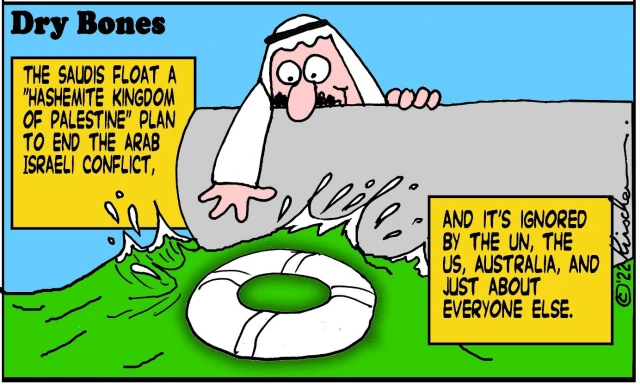
The Saudi-based Hashemite Kingdom of Palestine solution (HKOPS) - published in the Saudi Government-controlled Al Arabiya News on 8 June 2022 - trashed Saudi Arabian and Arab League policies calling to implement the two-state solution since 2002.
Amazingly none of those abovelisted has mentioned HKOPS as an alternative to the dead two-state solution.
Friedman wrote to me on 26 September 2022 that HKOPS “was not something for me to write on right now." Friedman has since failed to answer several requests asking when the right time will come.
Even worse – Secretary-General Guterres has refused to even acknowledge scores of my emails sent to him drawing his attention to HKOPS and urging him to bring this Saudi-based solution to the General Assembly and Security Council for consideration and adoption.
Group silence and denial of the existence of HKOPS has taken root at the UN - enabling Saudi Crown Prince Mohammed Bin Salman (MBS) to avoid joining the Abraham Accords until a “clear path to a two-state solution” is secured.
The UN - abandoning the two-state solution and adopting HKOPS to replace it - remains the clearest path to peace.
The author acknowledges the helpful research assistance provided by the Google AI platform during the preparation of this article.
The author has a Facebook page: “Hashemite Kingdom of Palestine supporters”
You might also like to read this: