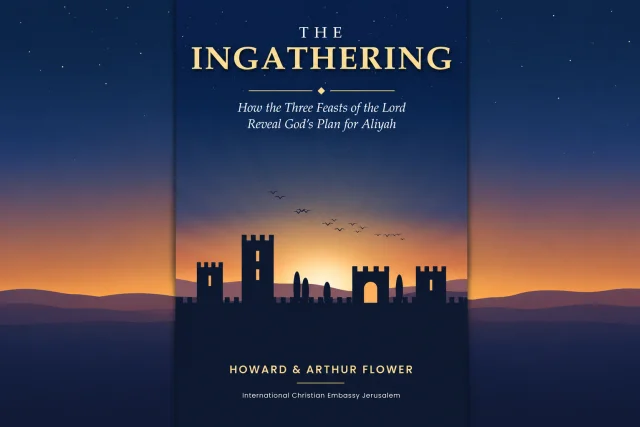
ICEJ eBook review: The Ingathering: How the Three Feasts of the Lord Reveal God's Plan for Aliyah

Overview
The Ingathering is a concise, accessible work of Christian Zionist theology that argues the seven biblical feasts of Leviticus 23 serve as a prophetic blueprint for the modern return of Jewish people to the land of Israel—a phenomenon known in Hebrew as aliyah. Authored by Howard Flower, Director of the ICEJ's Aliyah Department, and Arthur Flower, the book is published by the International Christian Embassy Jerusalem, an organization that has facilitated Jewish immigration to Israel since 1980. The book functions simultaneously as biblical exposition, prophetic interpretation, and organizational advocacy for the ICEJ's mission.
Structure and Content
The book is organized into three parts, following the traditional division of the biblical feasts into spring and fall cycles:
Part One: The Spring Feasts examines Passover, Unleavened Bread, Firstfruits, and Shavuot. The authors argue these feasts tell the story of redemption—the Lamb, the leaven, the resurrection, and the Spirit—and were fulfilled in the first coming of Yeshua (Jesus). Each feast is connected to aliyah: Passover as the door to the journey home, Unleavened Bread as the call to holiness and separation from exile, Firstfruits as the pledge of a greater harvest of returning exiles, and Shavuot (Pentecost) as the "Feast of Ingathering" par excellence.
Part Two: The Fall Feasts explores Trumpets, Atonement, and Tabernacles. Here the authors develop their central thesis: that the fall feasts speak of gathering, cleansing, and dwelling—and are being fulfilled in the return of Jewish people to their land. The Feast of Trumpets announces the final regathering; the Day of Atonement promises cleansing after the gathering (emphasizing what they call "the order of grace"); and the Feast of Tabernacles (Sukkot) is identified as the ultimate Feast of Ingathering, when God will dwell with His people and the nations will come to worship in Jerusalem.
Part Three: The Ingathering in Our Generation applies this theology to the present day, documenting contemporary aliyah statistics (over 20,000 immigrants from 100+ countries in the Jewish year 5786), the return of the Bnei Menashe from India (with a plan to bring approximately 6,000 by 2030), and the Church's calling to participate through prayer, giving, advocacy, and welcome
Strengths
Accessible and Devotional Prose. The book is written in a warm, inviting style suitable for lay readers. Short chapters, clear headings, and frequent scriptural quotations make it easy to read and digest. The author has a gift for making complex prophetic connections feel intuitive.
Clear Theological Framework. The organizing principle—spring feasts fulfilled in Messiah's first coming, fall feasts being fulfilled in the ingathering of Israel—is coherent and consistently applied. The author makes a compelling case that the feast calendar is not merely commemorative but prophetic, and that the ingathering of Israel is a present-day fulfillment of that prophecy.
Emphasis on Grace. One of the book's most theologically significant contributions is its insistence on "the order of grace" (Chapter 6). Drawing on Ezekiel 36:24-26 and Deuteronomy 30:4-6, the authors argue that God gathers His people before cleansing them, not because they deserve it but for the sake of His holy name. This is a robust articulation of salvation by grace alone, applied to the national ingathering of Israel. The parallel drawn between Israel's ingathering and the believer's salvation—both monergistic works of God—is pastorally powerful.
Practical Church Application. Chapter 9 offers concrete ways for Christians to participate in the ingathering: pray, give, advocate, welcome, go, and teach. This moves the book from abstract theology to actionable discipleship, fulfilling its stated goal of kindling "a fire in your spirit" (p. 11).
Contemporary Relevance. The documentation of current aliyah statistics, the Bnei Menashe return, and ICEJ's role in funding flights gives the book a sense of urgency and immediacy. The authors write as participants, not just observers, which lends authenticity to their claims.
Theological Assessment
The Ingathering stands within the tradition of Christian Zionism, a movement that believes the modern return of Jewish people to Israel is a direct fulfillment of biblical prophecy and a precursor to the return of Christ. The authors align with a "two-ingathering" model: Israel gathered from the nations, and the nations gathered to Israel's God—both pictured in the two leavened loaves of Shavuot (Leviticus 23:17).
The authors' emphasis on grace is genuinely commendable and theologically sound. Their insistence that God gathers Israel before cleansing them is consistent with Pauline theology (Romans 11:25-29) and provides a needed corrective to any works-based understanding of Israel's restoration.
Conclusion
The Ingathering is a heartfelt, accessible, and theologically ambitious book that will resonate deeply with readers who share its Christian Zionist convictions. For those already committed to the ICEJ's mission, it will serve as a powerful devotional resource and a call to action. For readers outside that tradition, it offers a clear window into how Christian Zionists interpret the feasts of Israel and the modern return of Jewish people to their land.
The book's greatest strength is its pastoral warmth and its practical call to participate in what the authors believe God is doing in our generation. Even the secular will benefit from understanding this perspective, which shapes the beliefs and actions of millions of Christians worldwide.
The Ingathering is recommended for readers interested in Christian Zionism, biblical prophecy, Jewish-Christian relations, and the theology of aliyah.