Young Americans hold more anti-Israel & antisemitic views than their elders – Yale survey
Two thirds of respondents said they want to stop or reduce military aid to Israel
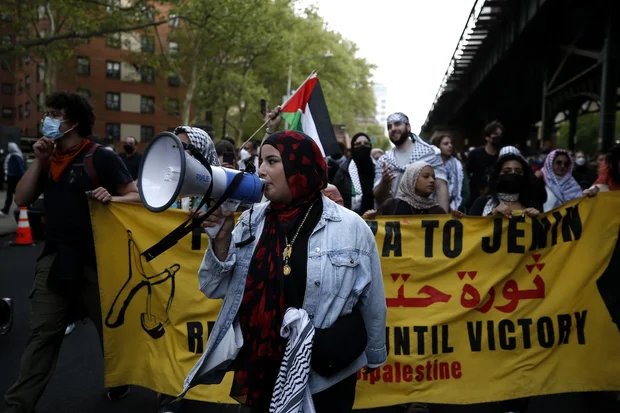
Younger voters are much more likely to hold anti-Israel and antisemitic views than older Americans, according to a new survey among over 3,400 registered U.S. voters by the Yale Youth Poll, an undergraduate-led research organization.
The poll sampled 3,426 registered voters, including 1,706 voters aged 18-34, and was weighted for age, sex, race, education, and party identification with a margin of error at ±1.7% for the full sample, and ±2.4% for the youth sample.
The poll follows a recent increase in reports suggesting that there is a rise in antisemitism among young Americans, and particularly among those on the political right.
A recent survey conducted by the Manhattan Institute found that 17% of Republicans hold views it categorized as “anti-Jewish,” while noting that consistent church attendance is the strongest predictor against holding such views.
While some leading Republicans have taken a vocal stand against right-wing thought leaders who have peddled antisemitic ideas, most notably Tucker Carlson, Vice President JD Vance told NBC News last week that he disagreed that there was a “simmering antisemitism that’s exploding” among young conservatives.
According to the findings of Yale Youth Poll, just 8% of voters said that they believed that Jews have had a negative impact on the United States.
However, this was much higher among younger voters, as 18% of 18- to 22-year-olds, and 15% of 23- to 29-year-olds, said Jews had negatively impacted the country.
The survey asked respondents whether they agreed with three statements commonly considered to be antisemitic: First, that Jews in the U.S. are more loyal to Israel than to America; second, that it’s appropriate to boycott Jewish American-owned businesses to protest the war in Gaza; third, that Jews in the U.S. have too much power.
“Among all voters, 70% disagreed with all three of these items. But the same is true for just 57% of 18- to 22-year-olds and 60% of 23- to 29-year-olds,” the survey found.”
Similar to the findings of the Manhattan Institute poll, minority respondents were slightly more likely to agree with at least one of the antisemitic statements. 74% of White respondents disagreed with all three statements, but only 63% of Hispanic, 62% of Black, and 57% of Asian respondents disagreed with all three.
“Young white liberals were much more likely to disagree with all three statements (73%) than young white conservatives (55%),” according to the survey’s authors.
While there were no clear ideological divides in the overall sample, voters between 18-34 years who self-identified as “extremely conservative” were “much more likely to agree with at least one statement (64%) than 18-34 year old voters in general (38%) or any other ideological subgroup of young voters.”
Regarding Israel, a strong generational divide emerged on the crucial question of whether Israel should exist as an explicitly Jewish state, a non-Jewish state, or not exist at all.
Only 46% of all respondents said they believed Israel should exist as an explicitly Jewish state, 18% said that while Israel should exist, it should be a non-Jewish state; and 5% said Israel shouldn’t exist at all (5%).
However, a full 15% of respondents under 30 years of age replied that Israel should not exist, and less than 30% believe that Israel should exist as a Jewish state.
Once again, minorities showed a greater hostility to Israel, as Black (24%), Asian (30%), and Hispanic (36%) voters were less likely to say that Israel should exist as a Jewish state than White voters (51%).
On this question in particular, a large proportion of the respondents said they were “not sure” how to answer, including 31% overall, over 30% among those under 30, and up to 46% among voters 35-44.
Regarding another key question for Israel, the survey found that “young voters overwhelmingly support decreasing American military aid to Israel, or ceasing aid entirely.”
46% of those under 30 said they support a total stop to military aid to Israel, and another 22-23% said they want to reduce it.
Overall, 43% said they want to stop or decrease aid, 31% said they want to maintain current levels, and only 9% said they would like it to increase.
“The poll results also showed that self-identified Republicans, conservatives, and 2024 Trump voters were more likely to favor either increasing or maintaining the current level of military aid to Israel, while self-identified Democrats, liberals, and 2024 Harris voters were more likely to favor decreasing aid or stopping it entirely,” the survey found.
Popular article:

interview Easter message of resurrection hope amid war at Jerusalem's Garden Tomb

biblical commentary Let my people go: a Passover message for today

4 IDF soldiers killed, 2 wounded in fighting in southern Lebanon, as Israel eliminates dozens of Hezbollah terrorists

Receive latest news & updates
A message from All Israel News
Help us educate Christians on a daily basis about what is happening in Israel & the Middle East and why it matters.
For as little as $10, you can support ALL ISRAEL NEWS, a non-profit media organization that is supported by readers like you.
Latest articles:

The last votes that could change everything – Israel awaits count of 600,000 'double envelopes'

Election uncertainty weighs on shekel as Israeli stocks fall

Historic Arab voter turnout: Results for Ra'am, Joint List shatter records but could harm chances to replace gov't

Netflix hit show 'Nobody Wants This' at center of controversy over star's Israel genocide remarks

Netanyahu, Eisenkot each announce intentions to form Israel’s next government