Thousands march to protest government's increase in funding for ultra-Orthodox sector
Judicial reform protestors demonstrate against coalition ‘buying votes’
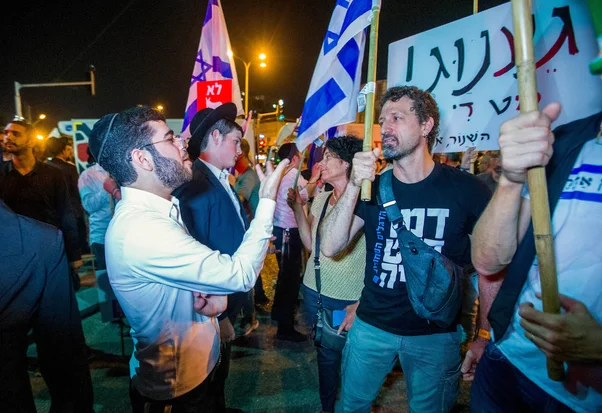
Several thousands of demonstrators marched through the predominantly ultra-Orthodox suburb of Bnei Brak on Wednesday evening to protest the Israeli government coalition’s decision to grant approximately NIS 13.7 billion ($3.8 billion) in funding to ultra-Orthodox Jewish causes.
The announcement came alongside news that Israel would receive less tax revenues this year. For many Jews who are not part of the ultra-Orthodox Jewish community, the size of the approved budget has brought the issue of inequality in Israeli society to the forefront.
Secular protestors were particularly upset by the dramatic increase in funds to the ultra-Orthodox religious sector, amid rising housing and food costs in Israel.
The increased budget to ultra-Orthodox is slated to fund unaccredited yeshivas (religious schools for studying Torah), many of which do not offer any math, science or job skills training. Other funding will go to food voucher distribution to poor ultra-Orthodox families, in spite of the fact the majority of the men in the community do not work or earn an income.
In addition, ultra-Orthodox yeshiva students are exempt from Israel’s compulsory military service, while the rest of the population only receive exemption for serving in the Israel Defense Forces for health reasons.
The budget increase was part of the coalition agreements made by Israeli Prime Minister Benjamin Netanyahu during the election campaign in November.
Yogev Gardos, head of the Israeli Finance Ministry’s Budgets Department, warned on Sunday that the amount of money going to ultra-Orthodox institutions would create more incentive for ultra-Orthodox men not to work, claiming it would ultimately harm the economy.
“Increasing the budget for non-supervised private educational institutions, while establishing a mechanism for the provision of allowances through the distribution of food vouchers, and raising yeshiva budget funds are expected to create a system of anti-economic incentives that encourages an exodus from the labor market and lowers the earning capacity of ultra-Orthodox society,” Gardos wrote in his report about the budget.
Opposition leader Yair Lapid called the increased budget and allocation of funds to the ultra-Orthodox community as “irresponsible and corrupt.”
“This is the money of the productive public in Israel,” Lapid said in a video. “Instead of investing it in the education of our children, in lowering the unbearable high cost of living, in economic growth engines, in protecting day care centers in the Gaza Strip, they invest it in buying votes.”
The Wednesday evening protests in Bnei Brak passed peacefully, with no arrests and several groups of Orthodox men reportedly set up tables to hand out pastries and drinks to the protestors. In addition, while anti-judicial reform protests have drawn tens of thousands of demonstrators to Tel Aviv in the last 19 weeks, the Wednesday protest march drew somewhere between 2,000-4,000 people.
Popular article:

interview Easter message of resurrection hope amid war at Jerusalem's Garden Tomb

biblical commentary Let my people go: a Passover message for today

4 IDF soldiers killed, 2 wounded in fighting in southern Lebanon, as Israel eliminates dozens of Hezbollah terrorists

Receive latest news & updates
A message from All Israel News
Help us educate Christians on a daily basis about what is happening in Israel & the Middle East and why it matters.
For as little as $10, you can support ALL ISRAEL NEWS, a non-profit media organization that is supported by readers like you.
Latest articles:
With over 85% of votes counted, Israeli elections end without clear path to viable coalition

Trump to impose unity government on Israel? - Reports claim US president pushing for government without controversial ministers

US tells Gulf nations to prepare for possible military campaign in Iran following midterm elections
The last votes that could change everything – Israel awaits count of 600,000 'double envelopes'
Election uncertainty weighs on shekel as Israeli stocks fall