Signs of recovery emerge at war-ravaged Kibbutz Aza


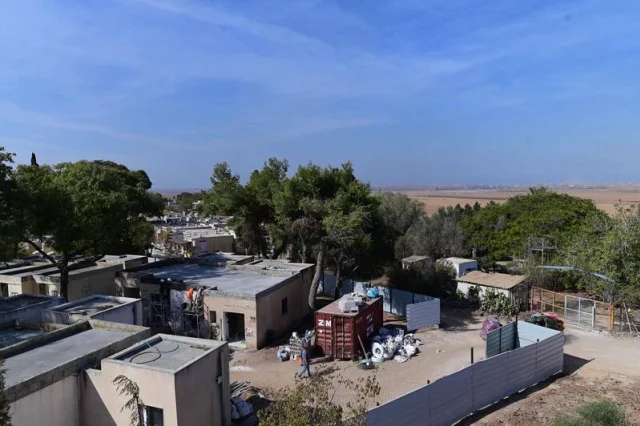
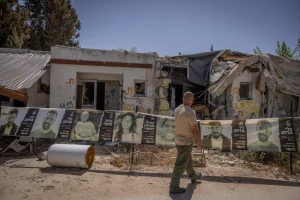
As the third anniversary of the Oct. 7, 2023, Hamas massacre approaches, Kibbutz Aza, one of the hardest-hit Israeli communities on the Gaza border that day, is slowly beginning to show signs of recovery.
On Sept. 1, the kibbutz opened its local kindergartens for the first time since the war began, while students at a new pre-military academy have already begun attending classes. Agricultural fields that provide employment for many kibbutz residents are also back in operation.
Around 50 of the approximately 300 families who lived on the kibbutz before Oct. 7 have returned so far, with several more families coming back each week. Kibbutz leadership has expressed optimism that additional families will return after the upcoming Jewish holidays.
The survivors of the initial Hamas assault were evacuated from the community, with many taking up temporary residence in Kibbutz Shefayim and Kibbutz Ruhama farther north. The Gaza border area was subsequently declared a closed military zone, preventing civilians from returning to their homes.
As security conditions improved, some families began returning and attempting to rebuild their lives. Others remain uncertain about whether they want to return, while some have decided not to go back to a place associated with painful and traumatic memories.
For those who have chosen to return, the process has been neither quick nor easy, and some continue to have second thoughts.
Sigal Moran, chairwoman of Kibbutz Aza, told Ynet News in a recent interview that she expects around 70% of the kibbutz's pre-war population to return by the end of 2027.
She described that figure as “a realistic target that depends on the security situation."
"The return process is complex,” she added. “It is shaped by fears, trauma and a lack of trust. We are rebuilding the kibbutz and rebuilding trust."
Community manager Tzion Regev said the return of residents has brought both hope and uncertainty.
"We're celebrating and not celebrating. It's moving to see the kindergartens open on Sept. 1. You start seeing people walking around; there are students from the new pre-military academy, new residents are arriving, new families. Life is starting to return."
However, he continued, "Everything is incredibly sensitive. We're cautious about our celebrations. Many people still aren't coming back. There's uncertainty. People are still deciding."
The IDF estimates that around 250 heavily armed terrorists invaded Kibbutz Aza on the morning of Oct. 7, 2023. The kibbutz's local emergency team attempted to defend the community, but only 14 members were armed with light weapons, and no reinforcements arrived during the first two hours of the attack.
Seven members of the security team were killed. The terrorists breached the kibbutz's perimeter fence, while some also entered by paraglider.
Several residents, including children, were kidnapped to Gaza and held hostage by Hamas terrorists. Entire families were killed, while others were forced to leave their homes and live as internally displaced people elsewhere in Israel.
The community's recovery has also been complicated by the need to rebuild essential infrastructure, including schools and medical facilities.
Still, some returning residents say they are determined to rebuild their lives in the community.
"With all the difficulty, and there is difficulty, it's good for us here. We want to raise our children here."
"We see friends who have also returned walking along the kibbutz paths, because now there's one area where people can move around. It's complicated, but we're dealing with it. I'm glad to be among the first to return to the kibbutz, and it gives me a sense of pride."
"It will be good here, and we hope it will be even better," the resident said. "It will be different, that's for sure, but different in a good way."
You might also like to read this: