Israel’s 26th Knesset convenes amid row over potential Change Bloc gov’t with Haredi, Arab parties
Eisenkot bloc submits bills aiming for Oct. 7 state inquiry, canceling judicial reform
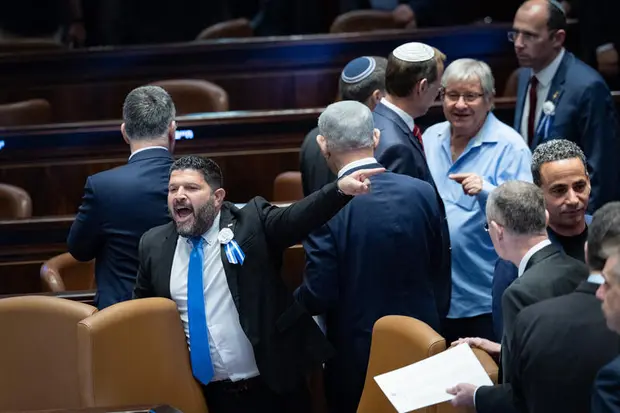
Israel’s 26th Knesset was sworn in and convened for its first session on Tuesday afternoon, in a solemn ceremony overshadowed by heckles and jeers as the outgoing governing parties continued attacking the Change Bloc for its negotiations with the Arab and ultra-Orthodox parties.
Outside, several hundred right-wing protesters demonstrated against a new government backed by the Arab parties, while the 120 lawmakers were sworn in.
Afterward, the session concluded with the singing of Israel’s national anthem “Hatikvah,” which was interrupted by taunts from Jewish Power MKs asking the Change Bloc, “Where are your partners?” Almost all Arab MKs, with the exception of Ra’am chairman Mansour Abbas and his Jewish No. 2 Yoav Segalovitz, had left the plenum for the anthem.
The bloc around Prime Minister Benjamin Netanyahu now holds 53 seats, though the allegiance of the ultra-Orthodox United Torah Judaism (UTJ) and Shas parties appears to be in doubt as the Eisenkot-led bloc tries to convince them to defect.
On the other side, the Change Bloc led by Yashar chairman Gadi Eisenkot has 48 seats, in addition to the 19 seats of the Arab parties, who are supporting the move to replace Netanyahu and could offer outside backing for a minority government.
Opening the new Knesset, President Isaac Herzog called on all sides to help calm the tensions in Israeli politics and society, while urging the new MKs that the Knesset “must serve out its full term; there are many tasks before it... You must do everything to avoid a repeat election.”
Eisenkot, who has received the mandate to form a new government, on Tuesday filed a petition to replace Knesset Speaker Amir Ohana (Likud) with Yashar MK Matan Kahana.
This is seen as a first step in a broader plan to take control of the parliament and enable the Change Bloc to advance the slew of new bills it filed the same day, aiming to roll back large parts of the last government’s legislation and establish a state commission of inquiry into the Oct. 7 failures.
The heads of the Change Bloc also agreed on several other appointments for the Knesset’s temporary committees until a government is formed. The most important is the powerful Foreign Affairs and Defense Committee, which will be headed by Yisrael Beiteinu leader Avigdor Liberman.
This committee is tasked with discussing a potential new IDF draft law, which has again emerged as one of the most sensitive issues in the coalition negotiations.
While Eisenkot reportedly seeks to add the Islamist Ra’am party as a full member of a future coalition, Liberman has repeatedly ruled out receiving any support from the Arab parties, instead advocating for a coalition with both ultra-Orthodox parties, which would grant Eisenkot a 61-seat majority.
However, the ultra-Orthodox party leaders have made clear that they want significant concessions on the military draft issue, after the Change Bloc campaigned on harsh penalties for draft dodgers.
In a faction meeting ahead of Tuesday’s ceremony, Eisenkot stressed that his party “has a deep commitment to its compass” of a Jewish, democratic, liberal, egalitarian Israel. He also promised that he would not give up on his commitment to “service for all — for all Israeli citizens. Military service, national service, civilian service.”
Eisenkot’s Yashar and Yair Golan’s Democrats submitted proposals to repeal several controversial bills on Tuesday, including the law limiting the powers of the attorney general, the Judicial Selection Committee law, and Communications Minister Shlomo Karhi’s media overhaul.
Both parties also filed several other bills, including proposals by The Democrats to allow public transportation on Shabbat, civil marriage, enshrining equality as a Basic Law, and expanding LGBTQ rights, all of which are likely to trigger strong opposition from the ultra-Orthodox.
UTJ’s Yitzhak Goldknopf confirmed to Channel 12 that negotiations with Eisenkot’s camp have started, noting that “he knows what we want. There have been preliminary contacts, and there is room for negotiations.” Goldknopf also acknowledged parallel contacts with Netanyahu.
The channel reported that UTJ and Shas are likely to demand a one-year to 18-month hiatus from any military enlistment, as well as sanctions or arrests of Haredi draft dodgers, while negotiations for a new IDF draft law are being conducted.
UTJ head Yaakov Asher told the Haredi news site Kikar Hashabbat that the party will insist on three demands being met before joining any coalition.
The most important issue is conscription exemptions for yeshiva students and those in other Jewish learning institutes, he said. In addition, a potential coalition must commit not to decrease funding for Haredi schools or even condition funding on meeting core curriculum requirements. A third demand is to maintain “the status quo between religion and state,” referring to issues such as prohibiting commerce or public transportation on Shabbat.
At the same time, Naftali Bennett’s Together (Beyachad) party filed the “Servicemembers’ Bill,” which appears to run directly counter to UTJ’s demands. Bennett said the bill aims to “turn the pyramid upside down and put those who serve at the top of the national priority list.”
Meanwhile, Liberman reiterated his rigorous rejection of a minority government or any reliance on the two Arab parties while addressing the Knesset.
“I am working to put an end to the rule of Netanyahu — once and for all. Not a temporary end,” he said. “Any minority government will ultimately, quickly, return him to power [after a new election], with 70 seats, for another four years,” he warned.
“We talked about… conscription for everyone. Today it’s clear that we’ll have to go with a different model… a conscription law that survives the High Court test. That is currently the best model that can be implemented without all the mess, without blowing everything up, and without going to a new election,” he added.
However, comments from UTJ MK Meir Porush on Wednesday underlined that the path to success for the negotiations with ultra-Orthodox parties remains fraught, and not all Haredi MKs are supportive of cooperation with the Change Bloc.
Addressing the Knesset, Porush noted the “unlimited hypocrisy” on display as the Change Bloc tries to woo the Haredi parties: “For almost three years and throughout the last election campaign, people in the media and professional inciters conducted an uninhibited campaign of division against the ultra-Orthodox community.”
“You called us an alliance of [military draft] dodgers, as if the alternative will now be real service members—19 lawmakers from the Arab community.”
However, Porush said, “As soon as the political map changed, everything flipped overnight… the newspapers that attacked us mercilessly are starting to caress the Haredi community.”
“We weren’t moved by your incitement, and we aren’t moved by your attempts to flatter us either,” Porush concluded.
Popular article:

interview Easter message of resurrection hope amid war at Jerusalem's Garden Tomb

biblical commentary Let my people go: a Passover message for today

4 IDF soldiers killed, 2 wounded in fighting in southern Lebanon, as Israel eliminates dozens of Hezbollah terrorists

Receive latest news & updates
A message from All Israel News
Help us educate Christians on a daily basis about what is happening in Israel & the Middle East and why it matters.
For as little as $10, you can support ALL ISRAEL NEWS, a non-profit media organization that is supported by readers like you.
Latest articles:

Pro-Iran operative plotted attack on US airbase in Britain from NY prison

Israeli defense firm unveils SUPER ICE, new cruise missile built for long-range precision strikes
Netanyahu’s Knesset speech prompts Arab party leader to accuse him of hypocrisy, spreading ‘blood libels’
PA arrests several Arabs for selling homes to Jews after settler families move into 8 homes near Jericho

Pompeo, Blinken weigh in on Iran conflict, current US relations with Israel