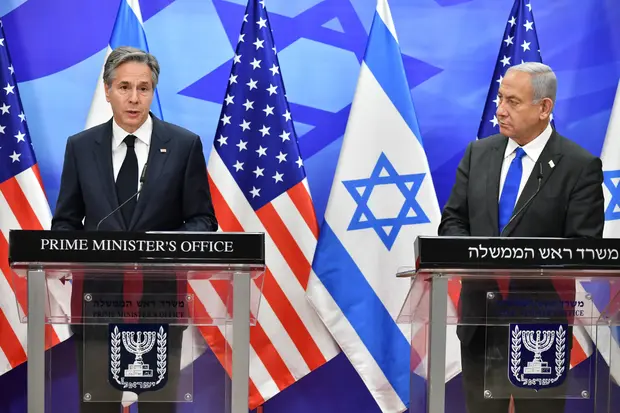
For Arab voters, ousting Netanyahu’s far-right government was priority
Arab parties are likely to support Israel’s next government while focusing on domestic issues
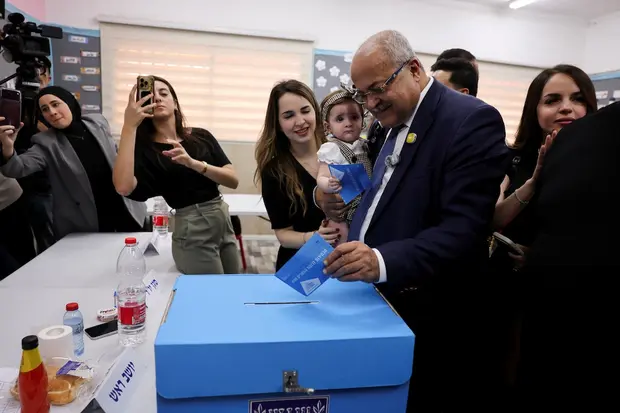
An unprecedented gain of 19 seats in the Knesset by Arab parties has drawn a wide array of responses ranging from support in various sectors of Israeli society to concern and outright racism.
With opposition leader Gadi Eisenkot tasked with forming a government, the Arab parties are poised to play a significant role in coalition negotiations. Both are intent on ensuring the new government replaces Prime Minister Benjamin Netanyahu.
“The erosion in our status was so fast that we felt that if this continues, we might be in a place that returning from it will be almost impossible,” said Mohammad Darawshe, an Israeli Arab political analyst, describing the marginalization of Arab society over the past four years.
Arab voter turnout reached an unprecedented 80% compared to 53% in the previous election.
What mobilized Arab voters in this particular election – the first since Oct. 7, 2023 – and why has such a strong showing unsettled many Israelis?
Much of the turnout is seen as a reaction to Netanyahu’s far-right coalition partners, particularly National Security Minister Itamar Ben Gvir, head of the Jewish Power party, and Finance Minister Bezalel Smotrich, head of Religious Zionism, and their policies.
“The first response was to the radicalization,” said Darawshe, a fellow at Givat Haviva and a longtime advocate of Jewish-Arab partnership.
Smotrich has used his political position to advance settlements in Judea and Samaria (West Bank) at the expense of communities inside Israel, including Arab towns. He and members of his party have also promoted plans to settle Gaza, the West Bank and Arab-majority areas in Israel’s periphery.
Ben Gvir, meanwhile, has done little to deal with soaring murder rates in the Arab sector, while instituting a death penalty for Palestinian terrorists.
Arab citizens fear that unchecked settlement expansion and violence against Palestinians could eventually spill into Israel proper, with consequences ranging from segregated hospitals – a proposal floated by Smotrich – to the displacement of Arab citizens.
“They demolished 1,800 Arab homes just in 2026 in the Negev mostly and also in the North. They arrested 1,400 Arab students just for daring to speak out,” Darawshe told ALL ISRAEL NEWS in an interview from Washington, D.C., where he is a visiting scholar at American University teaching a course this semester on the Israeli-Palestinian conflict.
Darawshe also credited Arab mayors, who rallied constituents to go out and vote in hopes of increased municipal budgets.
He further pointed to the strategic decision to consolidate political forces into two lists – Ra’am and the Joint List – rather than three. The arrangement reduced voter confusion while preserving enough competition to mobilize supporters.
Two parties, two approaches
Both Arab parties have shown interest in cooperating with the new government, though to different extents.
Mansour Abbas, the leader of the Islamist Ra’am party, recruited Jewish Israeli Knesset Member Yoav Segalovitz, a former police commissioner, as No. 2 – a clear bet to replace Ben Gvir in a future government.
Announcing his decision to run with Ra’am this summer, Segalovitz accused Netanyahu’s government of making life in Israel “intolerable,” especially for Arab citizens.
“As someone who served in the previous government and worked to combat crime, I know that things can be done differently, with cooperation between all state authorities and local authorities, but the condition for that is for someone to actually care,” he said.
While Ra’am would join a coalition, the Joint List is willing to help topple Netanyahu while remaining outside the government.
“We are ready for political cooperation to form an alternative government that will present a genuine alternative and commit to a fundamental change in the current government’s racist policies,” Joint List head Yousef Jabareen said following the election. “A government that will work to recognize the rights of the Arab public and end its exclusion, and that of its representatives, from the political system.”
Concerns over Arab participation
The prospect of Arabs entering the government has many Israelis on edge. Neither party characterizes Hamas as a terrorist organization and some members have described Israel’s war in Gaza as a genocide.
On election day, Netanyahu claimed, “They are trying to steal the election from us.” After the results were announced, his Likud party alleged foreign interference in the election – charges that remain unproven and that critics say were intended to undermine the results.
Netanyahu tried to capitalize on these concerns as Eisenkot accumulated 67 recommendations for prime minister, including from the Arab parties.
“They seek to erase the Jewish identity of Israel. They say so openly," Netanyahu warned. "They seek to deprive us of the ability to defend ourselves against our enemies.”
Darawshe dismissed concerns that Arab parties would dictate Israeli security policy or make decisions contrary to the country’s interests. Arab lawmakers will likely abstain on decisions such as war, while the 100 Jewish Knesset members, even the opposition, could vote with the government.
“Our parties will be a minority in the government, and the majority of the decisions will be Jewish-majority decisions,” he added.
Nor will Arab Knesset members seek sensitive security and intelligence portfolios, Darawshe said. Their priorities would likely include health and transportation. Arabs account for approximately 35% of Israel’s medical staff and a substantial share of its transportation workforce.
Darawshe previously helped broker the safety-net agreement for Arab outside support of Yitzhak Rabin’s government in the early 1990s. Of its 28 items, only one covered the Israeli-Palestinian conflict. The rest addressed socioeconomic issues affecting Arab citizens.
“And by the way, all of the 28 items were completed and fulfilled,” he said. “That was the most successful political partnership that Arab citizens had, and we refer to it as the golden ages in political engagement of Arab citizens in Israel.”
A longer process of integration
Still, Arab representation in the Knesset remains lower than that of the ultra-Orthodox relative to their demographics. Arabs make up about 21% of Israel’s population but only about 18% of the eligible voting population. Proportional representation would give them 22 seats.
The ultra-Orthodox, on the other hand, make up about 13% of the population, with 10.5% eligible to vote, translating to approximately 13 seats. They secured exactly that during this election but are down from 18 in the last Knesset – a disproportionately high share.
Nevertheless, Darawshe is hopeful about the broader transformation and ongoing integration of Arabs into Israeli society.
“After Oslo, we’ve gone through this mindset of realizing that Palestine is not coming to our towns,” he said. "We will forever be in Israel, and we better start the Israelization process.”
He pointed to growing Arab enrollment in Israeli universities, greater participation in high-tech and an expanding presence in medicine and engineering. Arab representation among university students has risen from approximately 3.5% 23 years ago to around 20% today. Participation in high-tech has grown from approximately 1% seven years ago to 7% today.
“I think it's part of internalizing the status of an eternal minority,” Darawshe said. “And as such, we need to build the capacity to find our place in Israeli society.”
Integration is also personal. Darawshe's own family experienced the devastating consequences of Oct. 7, 2023. His cousin, Awad, 23, was killed by Hamas terrorists while working as a medic at the Nova Festival.
Popular article:

interview Easter message of resurrection hope amid war at Jerusalem's Garden Tomb

biblical commentary Let my people go: a Passover message for today

4 IDF soldiers killed, 2 wounded in fighting in southern Lebanon, as Israel eliminates dozens of Hezbollah terrorists

Receive latest news & updates
A message from All Israel News
Help us educate Christians on a daily basis about what is happening in Israel & the Middle East and why it matters.
For as little as $10, you can support ALL ISRAEL NEWS, a non-profit media organization that is supported by readers like you.
Latest articles:
Netanyahu said to push for new Iran strikes as Trump claims ‘war is effectively over,’ touts diplomatic progress

Houston-based energy company joins Israeli partner in offshore gas exploration
Shin Bet’s investigation of election interference founders amid ongoing controversy

As Board of Peace alleges ‘insufficient’ response to storms, IDF notes increased winter aid to Gaza

Combat experience fuels boom in Israel’s defense-tech sector