










CENTCOM chief Cooper visits Israel, meets with IDF & Mossad heads amid reports of possible Iran strikes
Trump reported to be considering resuming strikes in Iran with Israel based on recent intelligence
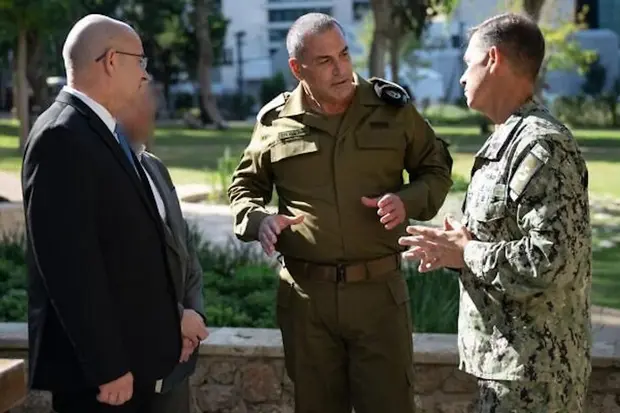
U.S. Central Command (CENTCOM) commander Admiral Brad Cooper met with Israeli security officials Wednesday, amid uncertainty regarding possible resumption of military operations in Iran.
During his visit, Cooper met with IDF Chief of Staff Lt. Gen. Eyal Zamir, Mossad director Roman Gofman, Air Force chief Maj. Gen. Omer Tischler, the Head of the Military Intelligence Directorate, and the Head of the Operations Directorate, and other senior commanders from both militaries.
Admiral Cooper met with the Israeli security officials as part of his visit to the Middle East.
According to reports in Hebrew media, the agenda focused on preparations for a potential resumption of conflict with Iran.
“During the meeting, they discussed regional developments and shared security challenges,” a statement by the IDF said. “Furthermore, they addressed the importance of deepening strategic and operational cooperation between the militaries, tightening coordination, and strengthening joint readiness to address a variety of scenarios.”
The meeting involved a joint situational assessment with the U.S. military, including comparing intelligence and coordinating operational plans. According to Channel 12, the IDF Deputy Chief of Staff said that, if no agreement is reached, military operations should resume.
Israeli defense officials assess that even if an attack does not topple the Iranian regime, it could inflict significant damage to Iran’s nuclear and ballistic missile programs. Additionally, defense officials prefer to take advantage of the current state of U.S. support before the new Congress is seated.
The visit takes place as the U.S. military maintains a significant deployment in the region, with the USS Theodore Roosevelt recently arriving in the Middle East to relieve the USS George Washington after a four-month deployment.
U.S. President Donald Trump is considering launching another round of strikes on Iran, prompted by pressure from Israel and new intelligence regarding the restoration of Tehran’s military capabilities, the New York Times reports, citing U.S. and Israeli officials familiar with the discussions.
According to the report, Prime Minister Benjamin Netanyahu is seeking to persuade Trump to launch a joint air campaign against Iran, lasting around a week.
However, a senior Israeli official rejected the claim that Prime Minister Netanyahu is pressuring President Trump.
A spokesman for Netanyahu told the Times that the prime minister is acting to “safeguard the security” of Israel.
Israel is concerned, as intelligence indicates the regime has managed to rehabilitate significant parts of its ballistic missile and drone capabilities, even as it seeks to develop chemical and biological weapons capabilities.
Mossad Chief Roman Gofman visited the U.S. last week, where he met with CIA Director John Ratcliffe and other administration officials and presented them with the latest Israeli intelligence. According to a report in Reuters, Gofman attempted to persuade the U.S. to resume strikes on key Iranian military sites.
“Gofman's argument was that if the U.S. and Israel don't act now, they will have to take military action at a later stage but under more difficult conditions,” a source briefed on the matter told Channel 12’s Barak Ravid.
The head of the IDF Military Intelligence Directorate (Aman), Major General Shlomi Binder, also advocated for the resumption of strikes in talks with U.S. officials.
Israel was also the source of the intelligence that Iran planned to target senior U.S. officials using chemical agents, which led to the decision to relocate several U.S. officials to more secure locations, including Treasury Secretary Scott Bessent.
However, the Trump administration remains divided regarding whether the Iranian threat necessitates renewed military action, the Times report said.
While U.S. intelligence officials have also identified efforts by Tehran to expand its chemical and biological weapons capabilities, some assess that the regime is seeking to deter Israel and the U.S. from launching renewed strikes, rather than preparing for a preemptive strike.
At the same time, the U.S. military buildup in the region remains significant, with dozens of attack aircraft stationed in the Middle East, and a recent delivery of an additional Patriot missile battery to Israel.
The U.S. has also withdrawn military personnel from several bases likely to be targeted in the event of a resumption of military operations in Iran.
Popular article:

interview Easter message of resurrection hope amid war at Jerusalem's Garden Tomb

biblical commentary Let my people go: a Passover message for today

4 IDF soldiers killed, 2 wounded in fighting in southern Lebanon, as Israel eliminates dozens of Hezbollah terrorists

Receive latest news & updates
A message from All Israel News
Help us educate Christians on a daily basis about what is happening in Israel & the Middle East and why it matters.
For as little as $10, you can support ALL ISRAEL NEWS, a non-profit media organization that is supported by readers like you.
Latest articles:

Palestinian Authority seeks UNESCO recognition for Jerusalem bagel as Palestinian heritage

1,000 days since Israeli child Haymanut Kasau disappeared, family still has no information

NYC councilman warns anti-Zionist rhetoric in City Hall is fueling antisemitism

Israel’s attorney general orders halt to E1 settlement construction until new gov’t is established
‘There wasn’t a ton of trust’ vs ‘I admire you’ – Leaked transcript of Biden’s last call with Netanyahu contradicts memoir