400-year-old oak wood Jewish ritual immersion bath found in 'Auschwitz'
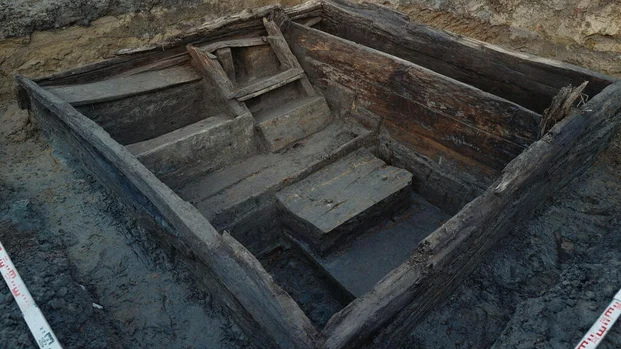
A wooden mikveh – Jewish ritual immersion bath – from the 17th or 18th centuries was found several meters beneath a brick bathhouse in January. The discovery was made in the town of Oświęcim, Poland, which Germans refer to as Auschwitz.
Builders discovered the oak wood mikveh after removing successive layers of earth during the construction of a parking lot at the site.
“Initially when we dug up a few stairs leading down and a wooden floor, it seemed that it could be a fragment of a wooden hut,” archaeologist Grzegorz Mądrzycki told the Polish publication, The First News.
Jews are known to have first lived in Oświęcim around the mid-16th century, calling the town Oszpicin. Local Jewish Museum Director Tomasz Kuncewicz said the mikveh might be dated to this time, according to Ynet news.
The town of Oświęcim also appears in Hasidic literature, referring to it as a meeting place for three great Hasidic rabbis: Elimelech of Leżajsk, his brother Zusja of Annopol and Shlomo Bochner of Chrzanów.
The Auschwitz Jewish Center (AJC), which houses the Jewish Museum and a synagogue, opened its doors in September 2000 to honor the Jewish residents of the town and to teach future generations about the Holocaust.
The Auschwitz extermination camp, built near the town and operated by the Nazis during World War II, was the largest and deadliest concentration camp of its kind, with 1.3 million people reportedly being sent there, including 1.1 million Jews. Of these, some 85% – 960,000 Jews – died there. Only 7,000 were liberated at its capture, as the Nazis had forced nearly 60,000 prisoners to march west to evade discovery or capture as Soviet forces approached.
The opening of the AJC followed the death of the town’s last Jewish survivor by four months.
After leaving the Poland at the end of WWII, the last Jew of Oświęcim, Shimek Kleuger, returned to the town in 1962, despite the protests of his family. He moved into the family house, which originally belonged to Kleuger’s maternal grandfather, and lived on the ground floor. At that time, he learned that other Jewish survivors had either emigrated to the United States or Israel.
Kleuger was 14 years old when WWII started in 1939 and might have seen the Nazis set fire to the Great Synagogue in September 1939.
Around 1994, Kleuger communicated to a visitor, Moshe Weiss, that he hoped “to leave Poland soon and join his brother and his family in Brooklyn, New York.”
Popular article:

interview Easter message of resurrection hope amid war at Jerusalem's Garden Tomb

biblical commentary Let my people go: a Passover message for today

4 IDF soldiers killed, 2 wounded in fighting in southern Lebanon, as Israel eliminates dozens of Hezbollah terrorists

Receive latest news & updates
A message from All Israel News
Help us educate Christians on a daily basis about what is happening in Israel & the Middle East and why it matters.
For as little as $10, you can support ALL ISRAEL NEWS, a non-profit media organization that is supported by readers like you.
Latest articles:

With over 85% of votes counted, Israeli elections end without clear path to viable coalition

Trump to impose unity government on Israel? - Reports claim US president pushing for government without controversial ministers

US tells Gulf nations to prepare for possible military campaign in Iran following midterm elections

The last votes that could change everything – Israel awaits count of 600,000 'double envelopes'

Election uncertainty weighs on shekel as Israeli stocks fall